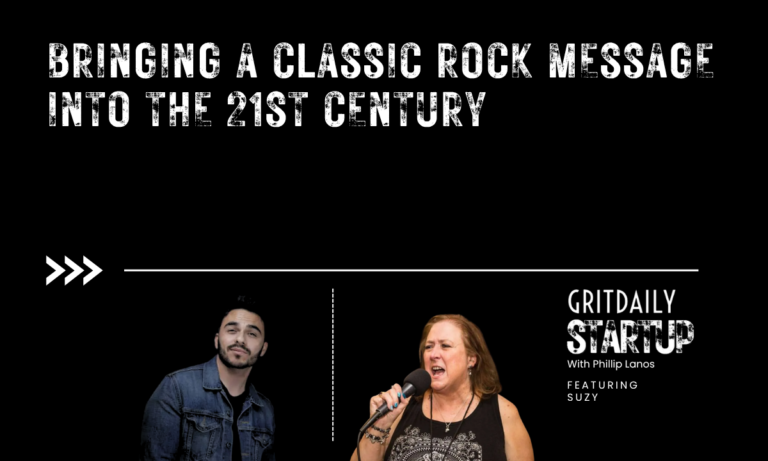
Suzy and the Substitutes is a name that says a lot about the project before the first note plays.
The name came partly from necessity. Suzy originally wanted to record simply as Suzy, but the search results were crowded, and nearly every usable name seemed taken. More importantly, the name reflected the way the music was actually being made. There was no fixed band in the traditional sense. Different players came in for recordings, music videos, and live performances, sometimes including well-known rock musicians who were available for a track but not for a show or a video shoot.
That rotating cast became part of the identity rather than a limitation. With Suzy at the center, the Substitutes can shift depending on the song, the session, and the moment, giving the project a flexibility that fits her path as an independent artist.
Her latest single, “21st Century,” carries that same mix of personality and purpose.
The song was originally written in 2017, recorded in an earlier version, and then left unreleased. Years later, while preparing material for a songwriting seminar, Suzy revisited it and found herself wondering why it had never come out. A few lines no longer fit the moment and needed updating, but the core message felt more relevant than ever. Working with longtime collaborator Norman Matthew, she rebuilt the track musically and arrived at a version that felt bigger, stronger, and better timed.
The song looks at the state of the world through the eyes of someone who grew up during the civil rights movement, the women’s rights movement, and an era when many people imagined the future as something more equal and humane. For Suzy, the 21st century was supposed to bring progress, not a retreat from rights and ideals people had fought to secure. The track is not only a critique of where things have gone wrong, but also a reminder that the story is not finished.
That message places Suzy in a long rock tradition.
Rock music has always carried room for protest, urgency, and cultural reflection, even if much of the current mainstream landscape has moved toward safer, more polished forms. “21st Century” reaches back toward the idea that a rock song can have a point of view without losing its force. The sound is large, but the reason for the song is just as important as the guitars behind it.
That combination has helped draw attention. “21st Century” reached number 28 on the Secondary Market Rock Chart, a milestone that reflects both the song’s reach and Suzy’s persistence as an artist still pushing forward on her own terms.
Her sound has been described in memorable ways, including “Joni Mitchell meets Metallica” and “Joan Baez meets Judas Priest.” The comparisons make sense partly because people often expect something softer when they see her or hear her story. Then the music hits harder than expected. That contrast has become part of the appeal, allowing Suzy to occupy a space that is melodic, reflective, and heavy at the same time.
The road there was not simple.
Suzy grew up in a small town with limited access to music education. Her school did not have the kind of program that might have helped a young singer develop early confidence, and she often had to catch up on her own. In college, she found herself surrounded by students who had grown up with choirs, music theory, and formal training she had not received. Instead of walking away, she learned what she could, looked up what she did not understand, and kept trying to find her way into music.
For years, that path was interrupted by life, work, marriage, and discouragement from people who may have meant well but did not understand the depth of her desire to sing. She spent time in public relations and advertising, continued going to concerts, met musicians, and eventually began writing songs after someone pointed out that she was already both a writer and a singer.
Learning to write songs became its own education. She bought books, taught herself lyric writing, and spent years working with the wrong collaborators before finding the right ones. Some early experiences were painful, including a recording project that was nearly lost after a hard drive was erased. By the time her first EP came together, she had already learned how difficult the industry could be, especially for an independent artist without a label, manager, or built-in support system.
The turning point came when she began working with Norman Matthew, a collaborator whose instincts aligned with hers. Over time, their creative relationship became intuitive enough that she no longer needed to explain every sound she was hearing. He understood the direction, sometimes building tracks that matched or even improved on what she had imagined.
That kind of partnership matters in a project like Suzy and the Substitutes, where the lineup may change but the creative center has to remain clear.
Her advice to younger artists comes from experience rather than theory. Do not let other people talk you out of the dream, even if they think they are protecting you. Find good people, because they do exist, but learn to recognize who is really helping and who is simply taking advantage. Be prepared to do the work yourself, especially as an independent artist, where promotion, social media, press materials, and business decisions often fall back on the artist.
Suzy’s story is not framed around overnight success, and that is part of what makes it useful. It is about continuing after false starts, starting again after disappointment, and refusing to treat age as the deadline for creativity.
For her, music has never been optional. It is closer to air, something she has needed since childhood and something she cannot imagine living without. “21st Century” may be a new single, but it carries the weight of a much longer journey behind it, one built on persistence, reinvention, and the belief that rock still has something important to say.
Want more Grit Daily Startup Show? Take a look at past articles, head over to YouTube, or listen on Apple Podcasts or Spotify.