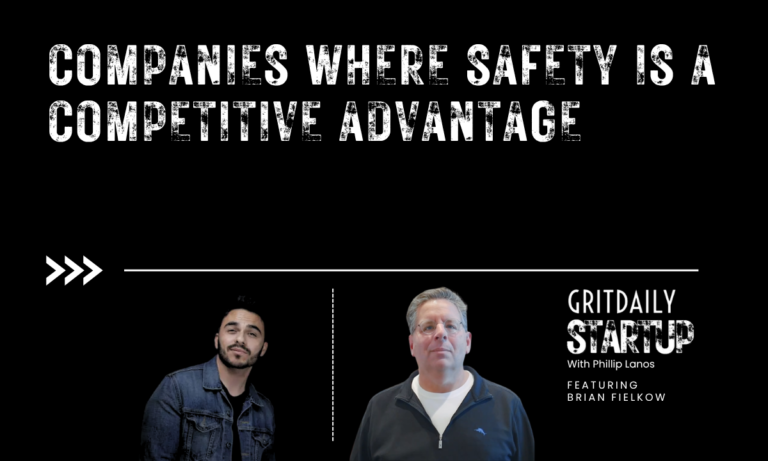
Brian Fielkow spent much of his career in industries where mistakes carry immediate consequences. Trucking, logistics, waste management, and risk-heavy operations do not leave much room for theoretical leadership ideas. Failures show up in damaged equipment, injured workers, broken customer trust, and financial losses that move beyond spreadsheets very quickly.
But the lesson Fielkow carried out of those industries and into leadership, acquisitions, and technology conversations is broader than transportation or workplace safety. The central idea behind his newest book, Make Safety Happen, is that safety was never supposed to sit quietly in a compliance department. It was meant to shape the way an organization operates from the inside out.
That perspective runs against how many founders build companies today. Startups often celebrate speed, aggressive growth, and constant iteration. Defenses are sometimes treated as obstacles rather than foundations. Revenue climbs first, and systems are expected to catch up later.
Fielkow sees the sequence differently.
Growth matters, but organizations eventually have to ask whether what they are building can survive pressure. A company may land customers quickly, but if processes are weak or teams are disconnected, cracks begin appearing in places that revenue numbers do not immediately reveal.
For him, sustainable organizations begin with people and process.
Hiring technically capable employees is only part of the equation. People also have to align with the values of the organization. A company can have talented workers and still create instability if everyone is operating from different assumptions. Processes become equally important, but only if they actually live inside the business rather than sitting inside training binders no one touches. Rules that exist on paper but never become part of a company’s operating rhythm provide little protection when stress arrives.
That structure creates something larger than risk reduction. It creates trust.
Fielkow learned that during his years leading Jetco Delivery, where safety itself became part of the company’s market positioning. Customers were not only evaluating pricing and logistics capabilities. Increasingly, they wanted confidence that vendors had safeguards in place protecting operations, data, people, and outcomes.
Not every customer cared. Some simply wanted the lowest price available.
The customers worth keeping often wanted something different.
They wanted predictability. They wanted confidence. They wanted to know they could sleep at night.
Risk management stopped functioning as overhead and started becoming a differentiator.
That same mindset carried into acquisition discussions. Buyers naturally study historical performance, but sophisticated buyers are often trying to answer a different question beneath the numbers. They are asking whether success happened because an organization was disciplined or because it happened to catch favorable market conditions.
Two businesses can produce similar financial results while telling very different stories underneath.
One may have repeatable systems, durable culture, and leadership practices that suggest future performance can continue. Another may simply have benefited from timing.
The difference matters because buyers are not paying for yesterday.
They are paying for tomorrow.
Fielkow also argues that culture becomes most visible at the frontline level. Many organizations unintentionally create separation between executives and employees doing the day-to-day work. In trucking, he saw how that divide often created disengagement and turnover.
Breaking that barrier required more than policy changes.
His teams created systems where drivers had direct input into decisions affecting their work, turning communication into something participatory rather than top-down. Employees stopped feeling like labor supporting the organization and instead felt like part of the organization itself.
That philosophy is taking on new relevance as artificial intelligence spreads into workplaces.
Fielkow sees the next phase of AI becoming less about surveillance and more about coaching. In trucking, cameras and telematics once felt punitive, functioning almost like digital watchdogs waiting for mistakes. Today’s systems increasingly provide real-time guidance that helps workers improve before managers ever become involved.
The difference is subtle but important.
One creates fear.
The other builds capability.
For a leader whose career has revolved around safety, that shift reflects a larger principle: organizations perform better when systems exist to strengthen people rather than simply monitor them. In the end, safety may have less to do with preventing disaster than creating conditions where people and businesses consistently operate at their best.
Want more Grit Daily Startup Show? Take a look at past articles, head over to YouTube, or listen on Apple Podcasts or Spotify.