For all the multi-billion-dollar valuations driving the generative AI boom, Large Language Models (LLMs) remain notoriously trapped in the digital ether. They can write elegant code, synthesize massive legal briefs, and generate photorealistic art. Yet, when asked to interact with the messy, physical infrastructure of the real world, the technology often hits a wall. An AI assistant can draft a brilliant, highly creative cross-channel marketing strategy, but ask it to pinpoint and rank physical billboards that target a specific demographic on a city block, and it will resort to a confident hallucination.
The missing link has never been a lack of algorithmic intelligence; it has been a data access problem. Traditional enterprise ecosystems have historically guarded their physical asset data inside proprietary, siloed dashboards and fragmented spreadsheets, making real-world logistics invisible to AI software.
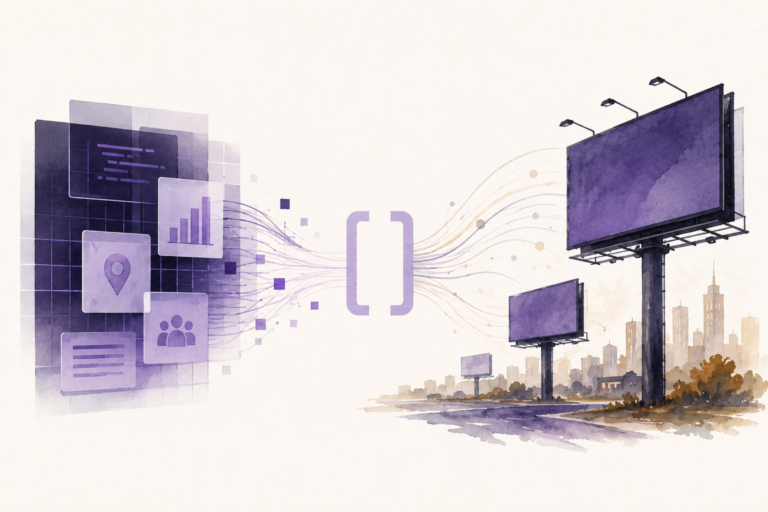
Onescreen, a modern out-of-home (OOH) advertising platform, has announced a massive infrastructure bridge to solve this specific bottleneck. By opening early access to its public Model Context Protocol (MCP) server, Onescreen has effectively indexed close to a million physical inventory listings and over 1,500 distinct audience personas, making them natively queryable for leading AI clients; including Anthropic’s Claude and OpenAI’s ChatGPT.
The Big Picture Shift: Giving AI Real-World Context
The broader significance of Onescreen’s announcement lies in its adoption of the Model Context Protocol (MCP). As an emerging open standard, MCP acts as a universal translator for AI. Instead of forcing companies to build custom, complex integrations for every separate AI model, or forcing human workers to leave their AI workspaces to dig through external web tools, MCP enables an AI agent to securely pull trusted, external data directly into its conversation.
For Onescreen, building this connection meant wrestling with decades of unstructured, legacy real estate and advertising data. Out-of-home advertising, spanning everything from digital highway bulletins to urban transit shelters, has traditionally been a heavily fragmented market controlled by hyper-localized vendors.
“We’ve always wanted OOH to be as queryable as any digital channel; something you can interrogate, not just buy,” said Greg Wise, Co-Founder and Chief Customer Officer at Onescreen. “Our own planners and media strategists already run this MCP server inside Claude Cowork day to day, supporting real campaigns for brands like Rippling and California Naturals. Marketers don’t want another dashboard to log into; they want the answer where they’re already working. We’re giving them access to the same tools we’ve been using here at Onescreen.”
Through this shift, an AI client no longer has to guess about physical spaces. If an enterprise user prompts an LLM to develop a strategy based on real-world physical locations or specialized demographic parameters, the model instantly references the real world, grounding the AI’s output in verifiable inventory, location intelligence, and target-audience concentration metrics.
Moving Beyond the Software Dashboard
This trend directly challenges the decade-long dominance of the specialized software dashboard. For years, corporate technology adoption meant forcing employees to log into dozens of isolated portals to extract specific datasets. Onescreen’s implementation proves a thesis rapidly gaining traction across the broader tech ecosystem: the future of enterprise software is not another website portal but a contextual data layer living directly inside the primary AI chat window.
“The legacy OOH stack is fragmented by default; you stitch together vendor decks and dashboards just to answer one question,” said Andy Luther, CTO at Onescreen. “The hard part wasn’t necessarily the protocol. It was making decades of messy market, vendor, and audience data behave like one clean resource an agent can actually use. When it works, you don’t notice any of it: you just get the insights you need, grounded in data you can trust.”
The rollout introduces two distinct tiers designed to capture both individual software builders and large enterprise holding companies. The first, Onescreen Research, is launched as a free public tier. It exposes the baseline infrastructure—the million live listings, audience-based market recommendations, and the 1,500+ audience personas—to any developer or user with an AI workspace.
The second tier, Onescreen Planner, is launching in a closed, invitation-only beta. This premium enterprise layer introduces tighter integrations, including increased rate limits, permission-based real-time pricing intelligence, and automated request-for-proposal (RFP) workflows that tie directly back into media buying engines.
As autonomous AI agents evolve from simple text generators into complex operational managers, tools like Onescreen’s system indicate where corporate infrastructure is headed. By transforming physical real estate and offline audience dynamics into software-readable context, the real world is finally becoming completely programmable.