You have probably walked past a Work Heights location without realizing it. There are seven of them across Brooklyn, in Crown Heights, Prospect Heights, Bed-Stuy, Prospect Lefferts Gardens, Boerum Hill, and Williamsburg, all operating as storefronts embedded in their neighborhoods rather than office towers set apart from them. That is not accidental. It is the whole point.
Work Heights has been independently owned and operating in Brooklyn since 2014, when its first location opened in a renovated Crown Heights building that had previously housed a junkyard and auto parts store. It has never raised outside capital. It has expanded one neighborhood at a time, following member demand rather than investor timelines. The result is a network of spaces that looks and functions quite differently from the branded coworking operators that have moved into Brooklyn in recent years.
“Work Heights is not trying to act like a large corporate operator,” says Sam Strauss-Malcolm, who owns the company. That sentence is both a description and a competitive position.
What Focused Work Actually Requires
The members who choose Work Heights tend to describe the same thing: a place where they can sit down and get work done without managing the environment around them.
Hunter J., a founder at Solar Responders, put it plainly in a review. The company, he said, provided exactly what he needed: a quiet workspace where he could sit for hours with minimal distractions, a relief from construction noise and busy cafes. Lauren P., a startup CEO-turned-CFO, described the network of locations across Brooklyn and the outdoor working spaces as the features that pushed her to recommend it. Guiane B., an entrepreneur at Arnette, pointed to the design: modern, minimal, bright, with the kind of symmetry she said actively supports her thinking.
These are not descriptions of a buzzy creative campus or a networking-forward community space. They are descriptions of somewhere to work.
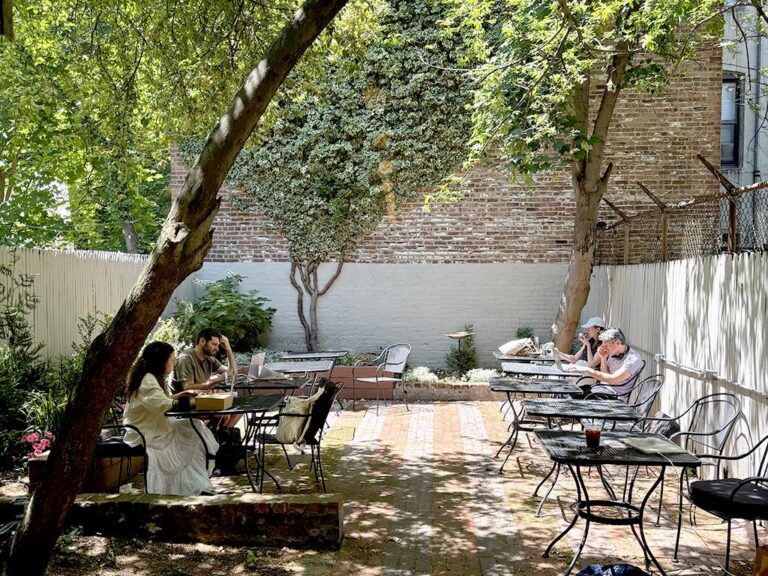
Work Heights builds its spaces around that specific need. Each location has quiet zones for solo focus and dedicated call zones so that a member taking a call does not pull the rest of the room out of concentration. Conference rooms are available for client meetings and team calls. There are outdoor backyards at six of the seven locations, useful in the warmer months and noted by members as a draw. Podcast booths sit at the Williamsburg, Bed-Stuy, and Crown Heights sites. Every location is dog-friendly. The furniture is Herman Miller throughout.
One Membership, Seven Neighborhoods
The structural advantage Work Heights has built over twelve years is the network itself. A single membership provides 24/7 access to all seven Brooklyn locations. A member based in Crown Heights can work from the Williamsburg site for a client meeting and return to their usual location the same afternoon without juggling two memberships or negotiating a day-pass.
For the freelancers, remote workers, and small teams that make up the majority of Work Heights’ membership, that geographic flexibility matters. Brooklyn is not a compact borough. Working across it without a fixed office is a real logistical problem, and the seven-location network is a practical solution to it.
The member companies whose logos appear on the Work Heights site include Runway, Nous Research, AINow, AirPals, ServiceNow, and Centre CR. Across the range, the common thread is independent professionals and small organizations, not large corporate tenants requiring dedicated floors.
What Sets the Independent Operator Apart
Beyond the spaces themselves, Work Heights has built a Local Offers program that connects members with discounts at other independent Brooklyn businesses: restaurants, bars, cafes, fitness studios, beauty businesses, and retail shops. The 10% off at a Crown Heights grocery store is one of the most-used. When a business joins the program, it gets a feature in the Work Heights weekly member newsletter. This is the kind of community infrastructure that an operator with seven neighborhood locations across a single borough can build. It is harder to replicate at scale.
The coworking market in Brooklyn is more crowded than it has ever been. As of early 2026, the borough has 90 coworking locations, according to CoworkingCafe data, representing 4.4 percent of total leasable office inventory. National operators are expanding here. The choice for a Brooklyn freelancer or founder has never been wider.
What Work Heights is offering is not the biggest space or the most polished branding. It is twelve years of operating in these specific neighborhoods, a product designed for focused work, and a network that covers Brooklyn without requiring a commute to Manhattan.