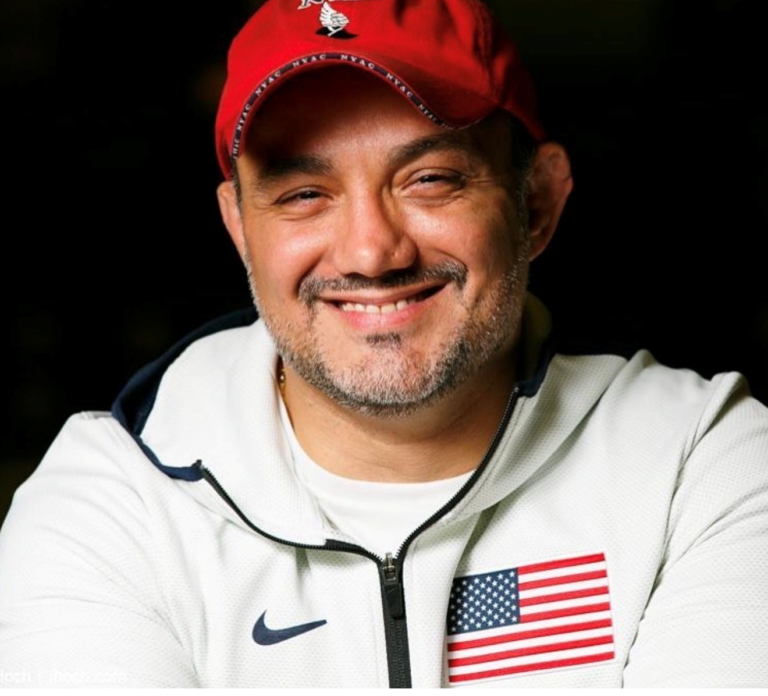
Nobody saw it coming. That’s usually how it goes with the people who build something real — they’re never the ones the room was expecting. They don’t walk in carrying the right last name or the warm handshake of someone who vouched for them. They walk in early, when the room is still empty. They stay late, when everyone else has already gone home. And they come back the next morning and do it again, not because someone asked them to, but because stopping was never something they knew how to do. For a long time — longer than was comfortable, longer than most people would have tolerated — Hooman D. Tavakolian was exactly that person. Head down. No applause. No guarantee that any of it was going to add up to something. Just the work, and the quiet, stubborn belief that it would.
What kept him going wasn’t strategy or optimism. It was something older than both — a philosophy pressed into him not in a classroom or a boardroom, but in the places where a person finds out what they’re actually made of. On wrestling mats, where the only honest answer was physical. In the heavy silence of a new country that had no particular interest in whether he made it. In the private string of setbacks that left no visible mark but shaped everything underneath the surface. He didn’t think his way to it. He didn’t choose it. It was built into him the way scar tissue is built — slowly, through repeated contact with things that hurt.
He eventually found two words that told the whole story — not as a slogan to put on a wall, but as the most honest accounting he could give of how the years had actually gone. Grit and Gratitude. One for what the journey cost him. The other for what it left behind when the cost was paid.
What the Mat Already Knew
There is a specific kind of loneliness that comes with being an outsider in a new country. The language sounds familiar but the rhythms are foreign. The rules are unwritten. The doors are everywhere and none of them have your name on them. Tavakolian arrived in the United States carrying exactly that weight: no connections, no roadmap, no cushion between him and the cost of failure. What he did carry was something the wrestling mat had already pressed into him: the understanding that the gap between where you are and where you want to be can only be closed one way.
Wrestling is an unforgiving teacher. It does not allow the comfortable lie that you almost had it, or that circumstances were unfair, or that tomorrow you’ll be better prepared. There is only the mat, the opponent, and the moment. Tavakolian learned to live inside that moment, really live inside it, without flinching, without looking for the door. He lost matches. More than he expected to. Each loss was its own education, not in technique, but in something harder to name: the capacity to stay in a situation that wants to break you and refuse, quietly, stubbornly, to break.
That capacity would become the most transferable skill he ever developed. Not the footwork or the grip strength. The refusal.
Because what the mat was teaching him, though he couldn’t have named it then, was how to lose without disappearing. How to stay fully present inside failure rather than retreating from it. That lesson would follow him into every room he ever walked into afterward.
The Long, Invisible Work
The years that followed don’t make for a clean story. Tavakolian has never tried to make them one.
Building a career in finance as an outsider is the kind of thing that happens in increments too small to feel like progress. There are no montages. There is only the alarm going off, the work in front of you, and the question of whether you’ll show up again tomorrow with the same energy you brought yesterday, knowing full well that the scoreboard hasn’t moved yet, that no one is watching, and that you’re running entirely on something internal, something you can’t point to or prove. He kept going not because success felt close, but because stopping felt like a deeper kind of loss than any setback he’d already absorbed.
Then, somewhere in the grinding middle of those years, something shifted. Not in his circumstances, but in his interpretation of them.
He stopped asking whether life was getting easier. He started asking who he was becoming because it wasn’t.
The failures he had carried like dead weight began to reveal a different nature. They were not evidence against him. They were deposits, slow and invisible and accumulating. The difficult years weren’t detours from the life he was building; they were the building. Every professional wound taught patience. Every personal setback deepened his perspective. Every public stumble built a resilience that no comfortable life could have produced. He began to see the pattern clearly: the seasons that had hurt the most had also shaped him the most, and there was something in that recognition that felt less like consolation and more like truth.
That truth became the second pillar of everything he would go on to do.
Gratitude. Not the soft, frictionless kind that comes easy when things go well, but the harder kind. The kind that looks at the years that nearly broke you and says: I am better for having survived that. That is a different order of gratitude entirely. That is the kind that changes how a person moves through the world.
The Life He Built with Both Hands
Today, Tavakolian holds a senior executive role in global finance, overseeing compliance and governance for a multi-billion-dollar investment organization. He has built the kind of career that justifies the struggle in every conventional sense. But sit with him long enough and the conversation doesn’t stay there. It moves toward classrooms in underserved corners of the world, toward wrestling mats that gave underprivileged kids the same lessons the mat once gave him, toward the simple and unshakeable belief that a life built by others holding doors open carries an obligation: you hold the door for the next person through.
Through Hoomanities, his nonprofit initiative, Tavakolian has worked to expand educational and athletic opportunities for young people who have little margin for error of their own, including supporting the construction of schools for girls in regions where access to education remains a privilege rather than a right. He doesn’t talk about this work in the language of charity. He talks about it in the language of debt, not shame, but responsibility. If the world gave you a chance, you give someone else one. The math is that simple.
The same logic carried him into sports diplomacy, where he has spent years using wrestling as a bridge across divides that politics could never cross. As a two-time Veterans National Champion and a leader within USA Wrestling initiatives, he watched the sport do something remarkable: create genuine respect between people who shared no language, no religion, no politics, nothing but the mutual experience of testing themselves at the highest level. At times when international tensions ran high, the mat became neutral ground. Because effort is a language with no accent. Discipline needs no translation. Respect between two competitors who have truly tested each other transcends every border that human beings have drawn.
There was no single morning when Tavakolian woke up transformed. There was no lightning bolt, no mentor with perfect words at the perfect moment, no shortcut that compressed the timeline. There were only thousands of ordinary days and the same quiet decision made inside each one: to show up, to work without applause, to stay humble when the recognition finally came, and to never let success make him forget the feeling of the floor.
That is what Grit and Gratitude actually means when you trace it back to its source.
Grit is not toughness performed for an audience. It is the private choice, made in the dark, to keep going when every reasonable part of you is looking for a reason to stop.
And gratitude, real gratitude, the kind earned rather than chosen, is the recognition that the fire you walked through wasn’t punishment. It was preparation. That the hardest chapters weren’t separate from the story. They were the story.
He still talks about wrestling the way men do when a sport has given them something they couldn’t have found anywhere else. Not with nostalgia for what was, but with a quiet, practical reverence for what it built. As if the mat is still teaching him. As if it always will be.
Because its most enduring lesson never changes.
You will get knocked down. The ground will be cold and the moment will be long. And in that moment, stripped of everything performed and everything borrowed, you will find out exactly what you are made of.
Grit built the journey.
Gratitude gave it meaning.
And the people he has lifted along the way? They are the proof that both were worth it.