As the world gears up for the FIFA World Cup 2026, expectations are higher than ever. For the first time in history, the tournament will span three nations: the United States, Canada, and Mexico. It will feature 48 national teams and 16 stadiums, making it the most logistically complex World Cup.
This expansion presents extraordinary opportunities and unique operational challenges compared to the previous edition in Qatar 2022. While Qatar’s centralized format allowed for rapid deployment and tight coordination within a compact geographic area, FWC 2026 calls for a decentralized yet tightly integrated model, stretching across time zones, languages, legal frameworks, and infrastructural capacities.
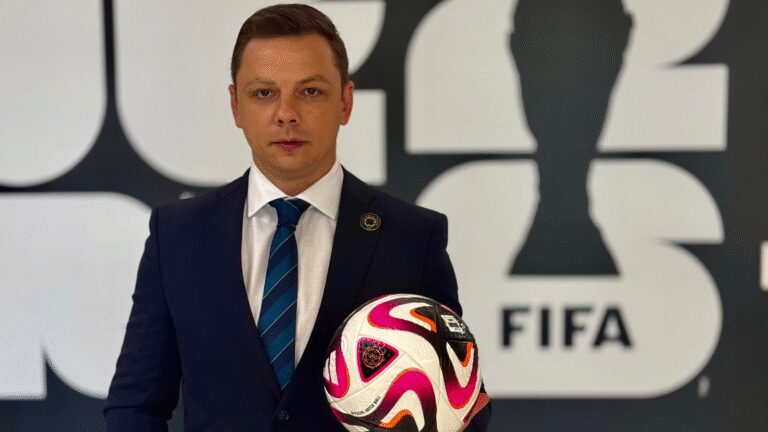
Making this global vision a reality has relied on Ivan Marchenko’s extensive leadership in international stadium operations, which has helped redefine how such mega-events are planned and executed.
Why Staff and Efficient Management Are Critical in Mega Events
For events of this magnitude, success depends on infrastructure and, more importantly, on the people who make operations happen: from security stewards and accreditation managers to senior venue directors. Each team delivers precision, safety, service, and memorable experiences in real time to millions, making each stadium a microcosm of international collaboration.
Ivan Marchenko emphasizes that staff performance rises when teams are effectively structured, motivated, and aligned. His leadership model draws on functional competence, emotional intelligence, cultural awareness, and a strong sense of shared purpose.
“You lead people who make the stadiums work,” says Marchenko. “When teams come from dozens of countries and work under immense pressure, your role as a leader is to create clarity, culture, and confidence.”
Efficient management ensures optimal use of resources, reduces risks, and enables rapid decision-making in unpredictable moments, something every match day inevitably brings.
Theoretical Foundations: Managing Multicultural Mega-Teams
Marchenko’s approach follows leading management theories and global best practices. Among his core influences are Hofstede’s Cultural Dimensions Theory, which is valuable in understanding how power distance, uncertainty avoidance, and individualism shape team dynamics in different countries.
Erin Meyer’s The Culture Map is a practical guide that Marchenko frequently recommends to staff working in multicultural settings. It helps build communication and trust.
Daniel Goleman’s Emotional Intelligence framework enhances the development of high-performing teams by emphasizing empathy, self-awareness, and social skills.
John Kotter’s Change Leadership Model prepares staff to adapt quickly during tournament-time changes and unexpected shifts.
Marchenko applies these principles as embedded practices in real settings, for instance, by adjusting feedback styles for teams from high-context or low-context cultures and establishing leadership hierarchies that respect regional expectations.
What Is Venue Management?
Venue Management is the art and science of orchestrating all operations within a stadium — before, during, and after an event — to ensure it functions safely, efficiently, and per international standards. It involves oversight of all functional areas such as security, ticketing, transport, hospitality, and broadcast, and coordination with local authorities, stadium owners, and event rights holders.
The role also requires satisfying all client groups: athletes, media, VIPs, and spectators, while managing operational readiness, rehearsals, incident response, and legacy planning.
It is multidisciplinary and fast-paced, where leadership and integration are the keys to success.
Ivan Marchenko’s Operational Methodology: A Three-Stage Framework
Years of operational leadership in global tournaments have empowered Marchenko to develop a three-stage planning methodology that is now widely adopted across FIFA and other major event organizations. The model provides both structure and flexibility, which are essential in managing venue operations on a global scale.
The first stage, High-Level Client Services Planning, ensures alignment with global stakeholders — rights holders, broadcasters, teams, and government agencies. It defines service levels, operational priorities, and overarching timelines. Marchenko ensures that every venue plan builds on a clear understanding of the clients’ needs to succeed.
The second stage, Venue-Specific Planning by Functional Area, involves each stadium developing its operational blueprint, driven by each functional area. These micro-plans consider venue-specific layouts, local laws, capacities, transport systems, and staff availability. This bottom-up planning empowers functional area leads to design their operations in locally appropriate and globally aligned ways.
The third stage, Cross-Functional Coordination and Alignment, integrates all plans through central coordination. This process includes regular alignment meetings, scenario testing, walkthroughs, and documentation consolidation. Here, Marchenko’s leadership creates an actual impact, transforming isolated plans into synchronized execution.
This model’s success rests on its balance between strategic vision and operational detail, an equilibrium that Marchenko has developed through direct experience.
Looking Ahead and Leaving a Legacy
As the football world anticipates 2026, Ivan Marchenko is already considering what will happen next. He believes a tournament’s legacy appears in the systems and people it elevates, beyond the spectacle.
With his teams, he works to leave behind an up-skilled local workforce trained in global standards, comprehensive playbooks and documentation for future event organizers, and sustainable operational models that minimize waste and maximize stadium value after the event.
“You measure success by applause in the final and by what remains once the lights go out,” says Marchenko.
Ivan Marchenko’s calm, clarity, and performance culture in the complex intersection of logistics, politics, and people continually advance the standards for stadium operations, one venue at a time.