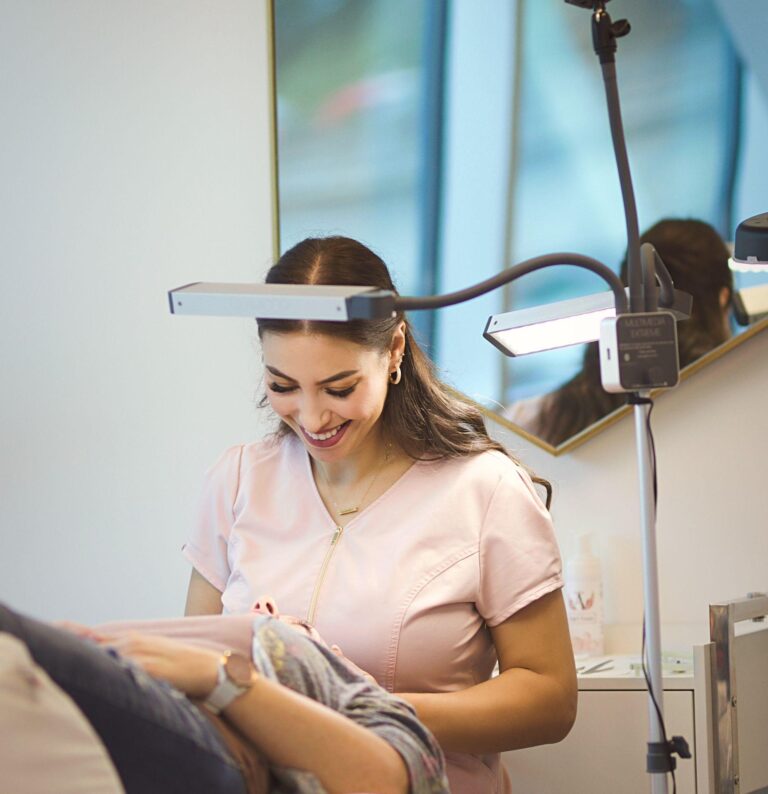
Most permanent makeup studios are built around a single promise: you will leave with better brows than you arrived with. Hello Bella and Brow, the Washington State studio founded by Inna Secu, is built around a different one, so that when the first appointment, done elsewhere, goes wrong, there is a path back.
That promise requires a specific set of capabilities. Secu has spent years assembling them.
When Previous Work Cannot Simply Be Covered
The demand for corrective permanent makeup has grown alongside the industry itself. As microblading, powder brows, and lip blush have become mainstream, so has the volume of clients left with results that aged poorly, faded to unexpected shades, or were placed without adequate regard for the face’s contours. Many arrive at a second studio hoping the damage can simply be tattooed over. Often, it cannot.
Inna Secu specializes in cases where that is the reality. A brow pigment that has oxidized to grey or shifted toward blue cannot be neutralized by laying fresh color on top; the undertones interact, and the result compounds the original error. Heavily saturated deposits from a previous session can make it impossible to achieve the fine, individual hair-like marks that an undetectable finish demands. Shapes drawn too high, too angular, or without reference to a client’s bone geometry leave a different kind of problem: the existing tattoo actively works against what the restoration needs to achieve.
Before any new pigment goes in, the existing work must be addressed on its own terms.
This is where Secu’s laser tattoo removal specialization becomes the foundation of her corrective offering rather than a peripheral service. She is trained and equipped to safely remove or lighten previous permanent makeup and tattoo work — giving clients the option to correct, refresh, or completely transform results that have faded, discolored, or simply no longer suit them. Using picosecond laser technology, which shatters pigment into particles small enough for the body to clear without the heat damage associated with older Q-switch equipment, she can selectively fade existing deposits to a point where new application becomes viable. Industry data indicates picosecond technology is roughly 70 percent more effective on cosmetic pigments than its predecessor — a gap that matters considerably on the sensitive tissue of the face, where the margin for thermal error is narrow.
The Clinical Logic of Restoration
What separates Secu’s method from a studio that offers laser as an add-on is integration. Removal is not the conclusion of the process, it is the preparation for what follows. Once existing pigment has been cleared to the necessary degree, she evaluates the underlying canvas: how the skin has recovered, what residual tone remains, and what the face’s actual proportions require. Only at that point does new work begin.
“My goal is to accentuate your natural beauty by drawing a shape that suits your bone structure perfectly, filling in the sparse areas on your eyebrows with my hyper realistic microblading technique, and highlight the color, as well as achieve the perfect symmetry, with innovative measuring techniques and symmetry app,” she explains in her studio’s own materials.
That sequence, assess, clear, rebuild with precision, is what distinguishes restoration from concealment. A concealment works around the constraints left by previous tattooing. A restoration removes those constraints, where the skin will allow it, and rebuilds from a more honest starting point. The difference shows in the result: one produces a brow that looks managed; the other produces one that looks earned.
What the Difficult Cases Demand
Corrective work runs on longer timelines than standard appointments. Laser sessions require spacing of several weeks to allow the skin to recover and the immune system to flush cleared particles. A full correction, from first consultation through laser preparation to final application, can extend across several months. Clients carry an intermediate state during that period, which requires both patience and trust in the practitioner guiding the process.
Studios that take these cases seriously absorb a level of complexity that most choose to avoid. Each session brings new variables: how the skin has responded, whether the pigment has cleared evenly, whether the planned restoration is still the right one given what the canvas now reveals. A practitioner prepared to make those judgments across a multi-session arc is operating well beyond the scope of a standard booking.
For the clients who reach Hello Bella And Brow after finding that complexity elsewhere, that extended commitment is precisely what they were looking for.