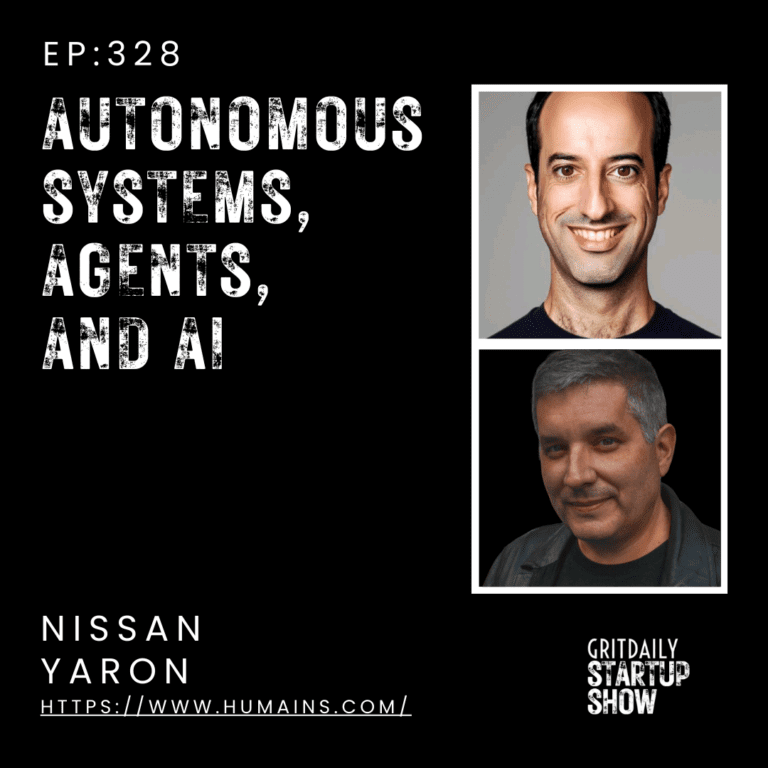
In this episode of Grit Daily Startup Show, host John Biggs sat down with Nissan Yaron, the CEO of Inpris, the creator of HumAIns. The company, which is working on an advanced integration of artificial intelligence (AI) in daily technologies, has found particular success in the automotive sector but is now aiming to expand.
Initially focused on enhancing car infotainment systems through AI, HumAIns has expanded its vision to a broader range of applications, propelling the company into the forefront of AI-driven autonomous systems and agents.
The origins of HumAIns trace back to its early days working on in-car assistance. The company developed a system combining voice assistants and finger gestures to interact with cars’ infotainment systems more safely and effectively, a development that was particularly crucial because traditional interfaces like touchscreens and smartphones tend to pose safety risks while driving.
However, the major breakthrough for HumAIns came later, with the adoption of OpenAI’s GPT-3 technology in 2021. After gaining early access to GPT-3, HumAIns adeptly utilized this large language model (LLM) to revolutionize how AI could operate within an infotainment interface.
The AI developed by HumAIns was capable of executing natural language conversations and carrying out specific tasks, such as drafting messages, navigating contact lists, and sending communications autonomously — a significant step beyond basic command responses.
The capability evolved HumAIns’ AI from a simple assistant into something more, with the advancements leading the company to develop a platform capable of generating and managing autonomous agents. These agents are designed not only to respond to user commands but to proactively lead conversations and execute tasks in parallel, mimicking human-like interactions.
A key innovation by HumAIns is the development of a specialized state machine architecture that allows the AI to process and store information dynamically during interactions. This structure mimics human cognitive processes, enabling the AI to act more like a human brain. This approach addresses common issues in AI, such as maintaining context and reducing errors known as “hallucinations,” where an AI might generate nonsensical or irrelevant outputs.
Still, while it is getting better, Yaron does not see any cause for concern when it comes to human jobs, at least not any long-lasting issues. He admitted that, in the beginning, it might “cause reduction in human works” as well as some layoffs. However, he also believes that quickly after, it will “create even more jobs because companies will grow and they will need people for multiple tasks.”
Businesses initially interested in cost-saving opportunities will discover that AI can also drive revenue growth and, subsequently, create new job opportunities requiring more complex, empathetic, or creative human skills.
As HumAIns advances, it exemplifies the potential of AI to transform industries by enhancing the capabilities of existing systems and creating new platforms for autonomous interaction. Moreover, it might just be a catalyst for human jobs, not a replacement for them. It represents a future where AI is not just a tool but a fundamental part of how businesses interact with their customers and manage internal processes.