Artificial intelligence (AI) is poised to transform healthcare, one of the most complex and vital industries. From diagnostics to treatment to preventative medicine, AI’s ability to analyze vast datasets and detect patterns offers the promise of unprecedented accuracy and speed.
Beyond medical care, AI streamlines administrative tasks, enabling more efficient workflows and freeing up healthcare professionals for direct patient care. However, challenges remain, such as ensuring data privacy, minimizing algorithmic bias, separating the signal from the noise, and navigating complex regulations. Despite these hurdles, AI’s potential to improve patient outcomes and efficiency signals a significant shift in healthcare’s future.
Leveraging his deep expertise across healthcare, business, and technology, Dr. Ronald Razmi, a seasoned cardiologist-turned-entrepreneur, has a clear vision of how AI can address the system’s longstanding challenges and the hurdles it must overcome to succeed.
The Roadblocks to AI Adoption in Healthcare
Dr. Razmi notes that despite its potential, AI faces considerable roadblocks when it comes to adoption in healthcare. The industry’s complexity, particularly in how decisions are made and who makes them, creates significant challenges. Physicians may want to use innovative AI tools, but often, they do not control purchasing decisions, which are instead made by administrators or influenced by insurance companies. As a result, even promising AI technologies can struggle to gain traction.
Dr. Razmi believes that the slow adoption of AI is rooted in the inherent conservatism and risk aversion of healthcare systems. Healthcare is far more complicated than consumer retail, where people can make instant decisions to buy products they like.
In healthcare, patients don’t directly make decisions. Physicians, administrators, and insurance companies are all involved in deciding which technologies should be adopted. Unfortunately, the actual practitioners typically have less of a say. This convoluted decision-making process often delays or blocks even proven innovations. Even with over 700 FDA-approved AI healthcare products, most still haven’t achieved meaningful adoption due to these barriers.
Further complicating matters, the euphoria surrounding AI can lead to misconceptions about its capabilities. During an interview on CNBC, Jamie Dimon claimed that AI would “cure cancer.” While Dr. Razmi acknowledges the immense potential of AI, he stresses that such bold predictions can mislead the public. “AI is not an overnight solution to the problems healthcare faces,” he says. “While it can help with administrative tasks and clinical workflows, it hasn’t factually fixed anything yet.”
Despite these challenges, the potential impact of AI, particularly in research, delivery, and prevention, is undeniable.
AI’s Potential in Medical Research, Healthcare Delivery, and Preventative Medicine
It’s only a matter of time before AI revolutionizes the healthcare industry. AI’s ability to process and analyze vast amounts of data can play a transformative role in medical research into diseases, genetic markers, and treatment pathways. Dr. Razmi highlights AI’s potential to analyze complex bodily functions like the microbiome, genomics, and other critical health areas that could unlock breakthroughs in human health. AI can identify patterns and correlations that could lead to major discoveries by analyzing data at a scale that humans simply cannot match.
Furthermore, AI can address some of the system’s most pressing issues in healthcare delivery, such as resource shortages. By automating routine administrative tasks and even assisting with clinical decisions, AI can free up valuable time for healthcare providers and allow them to focus on more critical matters.
One of the most exciting opportunities AI presents is the possibility of shifting healthcare from a reactive to a preventative model. Currently, most people only interact with the healthcare system when they are already sick. AI has the potential to change this by continuously monitoring health data and providing predictive analytics, enabling interventions before a problem becomes serious. However, for AI to drive preventative healthcare, significant investments need to be made, as the infrastructure needed to support these changes is not yet in place.
As Dr. Razmi cautions, while the potential is clear, AI is still in its early stages. Many technologies are not yet fully validated, particularly in areas like longevity, where AI-driven products are being marketed without sufficient clinical evidence to back up their claims. Once proven, the real challenges lie in integrating AI into the complex infrastructure of healthcare and ensuring that AI technologies can work within this system.
The Importance of Cross-Functional Expertise
Successfully integrating AI into healthcare requires more than just innovation. It demands cross-functional expertise. In Dr. Razmi’s view, solutions that combine clinical, business, and technological perspectives are far more likely to succeed. He notes that healthcare institutions are in dire need of frameworks on how to assess AI products and avoid analysis paralysis, where buyers become overwhelmed by too many choices and opt to purchase nothing. This expertise is crucial for determining which AI technologies will genuinely address institutional needs and which ones are simply unnecessary additions.
For AI to be effective, both buyers (such as healthcare institutions) and entrepreneurs must understand the full landscape. Buyers need to know how to differentiate between the many AI products on the market, assessing which technologies will truly add value to their most pressing pain points. Entrepreneurs, on the other hand, need to understand the industry’s priorities and challenges to ensure their products find product-market fit, addressing the right problems at the right time. Without this understanding, AI technologies are unlikely to gain adoption, regardless of how innovative they may be.
Dr. Ronald Razmi’s Journey in Healthcare and Technology
Without question, Dr. Razmi’s journey and career are paradigmatic of the cross-functional expertise necessary to advance AI adoption in healthcare. Dr. Razmi is uniquely positioned to help in this crusade due to his diverse, relevant, and far-reaching background.
He started his career at the Mayo Clinic and gained firsthand experience with clinical workflows and patient care. While doing his cardiology training, he was one of the few recipients of an NIH grant that taught him about digital technologies and their application in healthcare. One of his most notable contributions was as a pioneer in the application of MRI systems in managing cardiac patients — a breakthrough in applying digital technologies to medical practice. To help educate and train cardiologists in using MRIs to manage cardiac patients, Dr. Razmi built a software system and co-authored the textbook “Handbook of Cardiovascular Magnetic Resonance Imaging.”
His decision to pursue an MBA underscored his desire to bridge the gap between clinical practice and business, ultimately preparing him for a career in healthcare consulting and entrepreneurship. After earning his MBA from Northwestern University’s Kellogg School of Management, Dr. Razmi went on to work at McKinsey in corporate finance, focusing on healthcare consulting, private equity, and M&A. During this time, Dr. Razmi gained an even broader understanding of the operational challenges in the industry.
This combination of medical expertise and business acumen would serve him well when he later founded Acupera, a population health management software company. Acupera empowered healthcare organizations to use data, care pathways, and AI to industrialize key aspects of care delivery and patient management. While running the company for seven years, he encountered the real barriers to bringing technology into healthcare, something he hadn’t anticipated despite his years in the field. This experience informs his perspective on the complexity of AI adoption in healthcare and the need for expertise across various verticals.
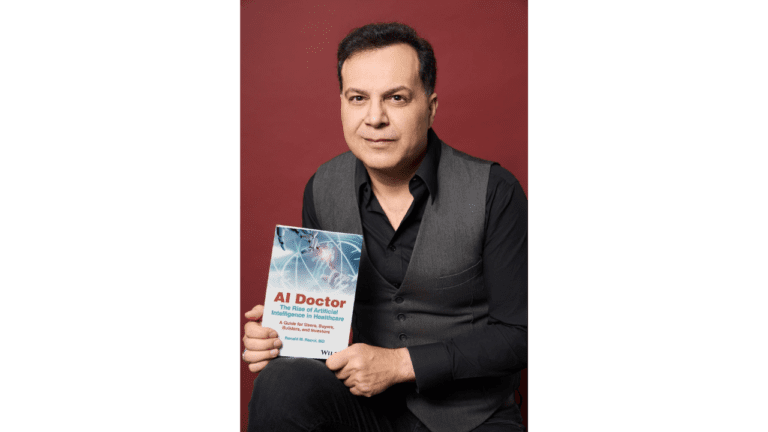
Dr. Razmi’s book, AI Doctor: The Rise of Artificial Intelligence in Healthcare, explores these complexities in-depth, offering insights into healthcare, AI, and the cross-functional expertise required to bring meaningful innovations to market. The book also provides frameworks for healthcare institutions to help them assess AI products and actually purchase products that will help their staff and patients. His blog, The AI Doctor, which has been running for three years, objectively dissects new AI-related topics such as longevity, preventative care, and medical research every month. Both platforms offer a unique perspective on the great promise of AI in healthcare and the monumental challenges of implementation at scale.
Dr. Razmi is putting his cross-functional expertise into practice (and his money where his mouth is) with a new venture capital firm, ZOI Capital, focusing on AI in healthcare. Named after the Greek word for “life,” ZOI Capital is not just about providing funding. It is about bringing the right expertise to the table to help AI companies navigate the complexities of the healthcare system. Many traditional venture capital firms invest broadly across multiple industries, but ZOI Capital distinguishes itself by deep specialization and focus on one technology in one sector, combining capital with hands-on guidance, helping AI companies understand the healthcare market and avoid common pitfalls.
Dr. Razmi believes private market investing in healthcare requires a specialized approach while leveraging this cross-functional expertise. Drawing comparisons to the original dot-com boom and the second wave of social media companies, he explains simply providing capital is not enough in today’s specialized AI healthcare market. Instead, investors must provide boots-on-the-ground direction, helping companies to commercialize their products and bring them into the healthcare environment.
The Future of AI in Healthcare and Longevity
In his new article on Fast Company about longevity, Dr. Razmi examines the opportunities and challenges in tackling one of humanity’s longest pursuits. The future of AI in healthcare is undeniably promising but must be approached with caution. As Dr. Razmi points out, many AI-driven healthcare products, particularly those related to longevity, are being marketed without sufficient clinical validation. For instance, companies offering microbiome analysis to sell “age biotics” for improving longevity are capitalizing on AI-driven theories that have not yet been proven in clinical trials. Dr. Razmi cautions consumers to remain skeptical and consult healthcare professionals before spending money on products that may or may not have any real benefits.
Dr. Ronald Razmi’s work at the intersection of healthcare, technology, and business puts him in a unique position to understand both the challenges and the opportunities that AI presents. Razmi’s vision for the future is one where AI not only improves healthcare delivery but transforms it into a system that is more proactive, efficient, and accessible. As AI continues to evolve, it will take the combined efforts of entrepreneurs, investors, and healthcare professionals to unlock its full potential.