
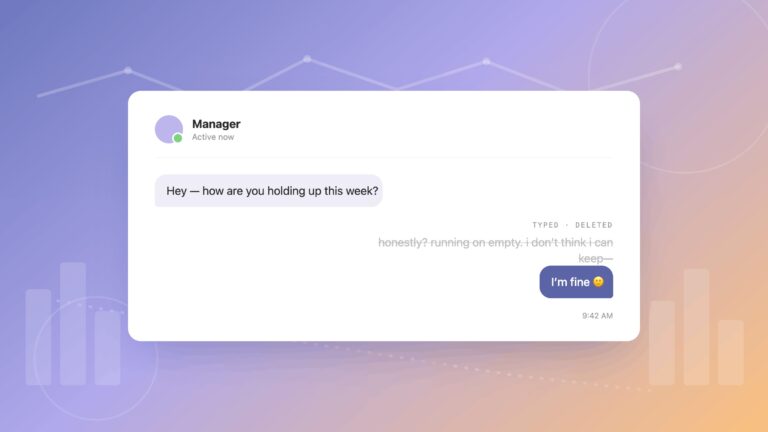
After quiet quitting and quiet vacationing, new data from precision psychiatry company NeuroKaire suggests the behaviors that have defined Gen Z in the workplace may have had a clinical explanation all along.
Employers have spent the better part of five years trying to decode Gen Z.
First came quiet quitting, the 2022 phenomenon where young workers stopped going above and beyond and did only what their job description required. Then came quiet vacationing, where they logged off without telling anyone and worked from the beach while pretending to be at their desk. Each trend generated its own wave of think pieces, management advice columns and generational hand-wringing. Managers asked what was wrong with this generation. HR leaders designed new engagement programs. Consultants built entire practices around the question.
But what if the answer was never about attitude?
A new report from precision psychiatry company NeuroKaire offers a different explanation for the behaviors that have defined Gen Z in the workplace. According to The Self-Medication Generation, a study conducted with research firm Prosper Insights & Analytics that surveyed more than 18,000 U.S. adults, nearly one in four Gen Zers are depressed. And for a generation already competing with artificial intelligence for their careers, coping in silence may have been the only option they could afford.
Dr. Daphna Laifenfeld, a Harvard-trained neuroscientist and NeuroKaire’s Chief Science Officer, said the data reframes a conversation that has been happening in the wrong terms. “The workplace behaviors that get labeled as generational quirks, the disengagement, the boundary-setting, the reluctance to go above and beyond, those may actually be symptoms of a mental health crisis that’s been hiding in plain sight,” she said. “This data puts a clinical lens on a conversation that has mostly been cultural.
A Generation With the Odds Stacked Against It
Gen Z did not enter the workforce on equal footing. They came of age during a pandemic, graduated into economic uncertainty and are now watching AI reshape the entry-level job market they were counting on. The NeuroKaire report adds another layer: depressed Gen Zers earn an average household income of $43,677, roughly 12% less than the rest of their generation. And more than one in four are unemployed, a rate higher than any other demographic in the study.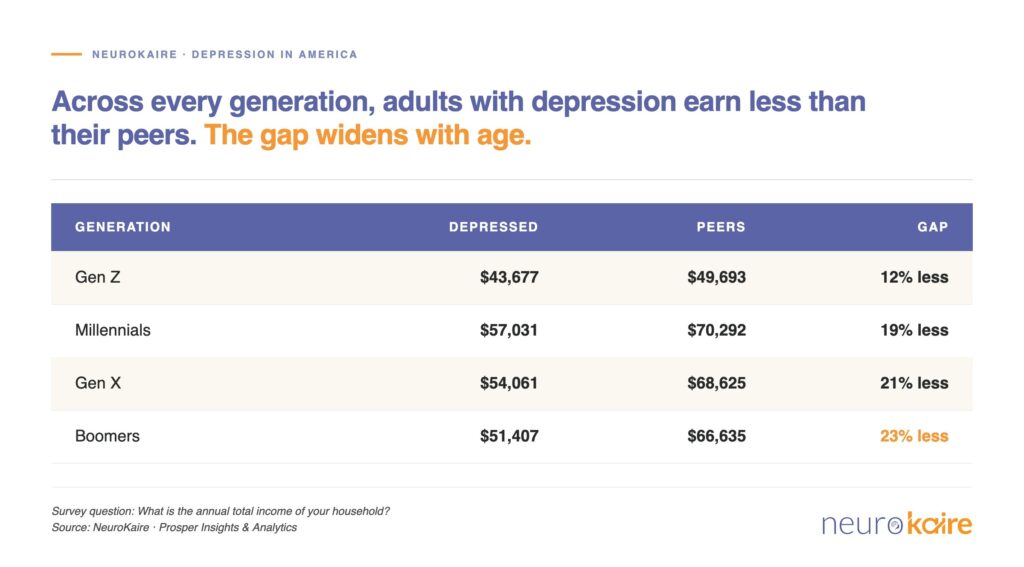
For those who are holding down a job, the math leaves no room for a mental health crisis. They can’t afford to take leave. Many can’t afford a specialist. So they show up every day and self-medicate with whatever they have access to, quietly coping, because drawing attention to the problem could cost them the job they can barely hold onto.
That pattern, coping in silence while keeping pace at work, is what the NeuroKaire data reveals as a generation-wide behavior: Quiet coping.
The First Generation to Walk Away From a Broken System
To understand why Gen Z is self-medicating, it helps to understand what happens when they try the traditional route.
The standard treatment path for depression starts with a doctor’s appointment, a prescription and a waiting period of four to six weeks to see if the medication works. For most people, it doesn’t.
Two-thirds of patients don’t respond to their first antidepressant, meaning the average person cycles through two or three prescriptions before finding something that helps. Each failed trial means more weeks of side effects, another copay, another follow-up appointment and continued lost productivity at work.
For a 24-year-old already earning less than their peers, every failed prescription is a financial setback they cannot absorb. And that’s assuming they can get an appointment in the first place. The NeuroKaire report found that depressed Gen Zers are 55% more likely than their peers to be on government insurance and less likely to have employer-sponsored coverage, meaning their access to psychiatrists and specialists is already more limited.
So Gen Z appears to be doing something no previous generation has done at this scale: functionally opting out of a mental healthcare system that doesn’t work fast enough, affordably enough or personally enough to meet them where they are. Not because they don’t believe in treatment, but because the current model fails them before it helps.
What Quiet Coping Actually Looks Like
The NeuroKaire report, drawn from a depression cohort of 3,737 Americans within the larger 18,000+-person survey, makes the self-medication toolkit–or what NeuroKaire calls the “shadow pharmacopeia”–visible for the first time. And it is more deliberate than it looks from the outside.
Cannabis and CBD have become frontline mental health tools. Half of depressed Gen Zers use marijuana. Among those who use CBD, 70% say they use it specifically for mental wellness, 58% more than non-depressed CBD users in their generation. These are not recreational choices layered on top of clinical care. For many, they are the care.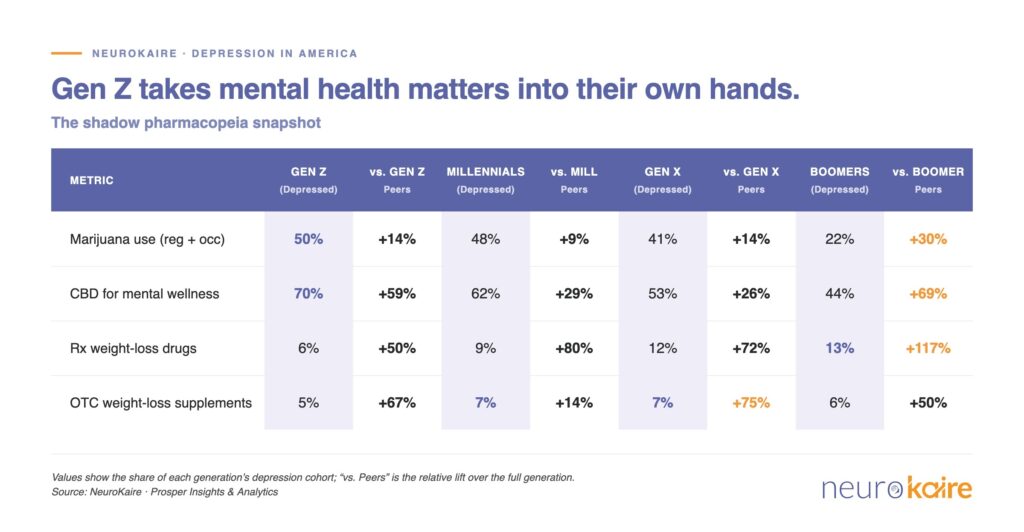
Their health decisions are shaped by people they know and trust, not by celebrity endorsements or pharmaceutical advertising. Nineteen percent say word of mouth influences what medicines they buy. That’s 52% more than the general Gen Z population. Social media plays an outsized role too, influencing their medicine purchases 37% more than it influences the rest of their generation. But only 8% look to celebrity influencers. This is not a generation blindly following trends. They are getting health advice from friends, peers and group chats because that is often the most accessible and affordable healthcare they have.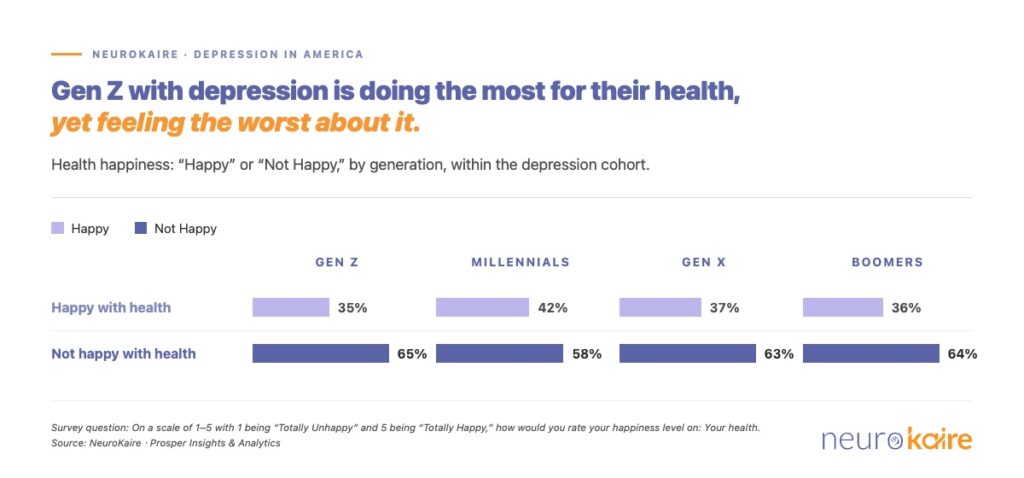
They are also investing in their bodies. Depressed Gen Zers are 47% more likely to be watching their calorie intake and 29% more likely to exercise at least three times a week. They are 39% more likely to be taking prescription weight-loss drugs than the rest of their generation, part of a pattern across every age group in the study where depressed Americans gravitate toward GLP-1 medications more than their peers. The connection between physical health and mental health appears to be something this generation understands intuitively, even when they cannot access formal psychiatric care.
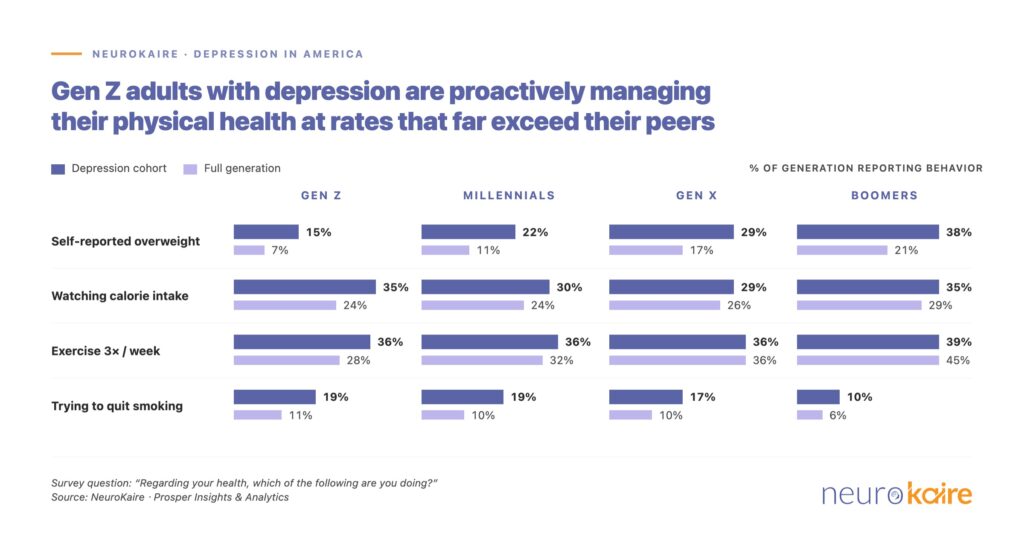
And perhaps most revealing: they are finding comfort in analog. Depressed Gen Zers are nearly twice as likely to have picked up crafting as a hobby and 57% more likely to read books. In a generation often dismissed as screen-addicted, the data shows a cohort reaching for hands-on, offline activities that offer the kind of control and calm that untreated depression makes hard to find elsewhere.
What Comes After Quiet Coping
The NeuroKaire data suggests that the workplace trends of the last five years may have had an underlying clinical explanation all along. Gen Z didn’t invent quiet quitting because they were lazy. Many of them were surviving. And the self-medication stacks they are building are remarkable in their resourcefulness, even as they highlight a massive gap in how depression gets treated in this country.
Laifenfeld said the gap is not one that willpower or better workplace perks can close. “This generation is all about controlling their own life and narrative, so what we’re seeing is them leveraging all the tools available to them,” she said. “Unfortunately, the traditional healthcare treatment model is an ineffective tool. You shouldn’t have to fail multiple medications over periods of months and years to then maybe find what works for your brain. The science and the tools now exist to match a patient’s neurobiology with the right antidepressant from the start. That is what NeuroKaire was built to do.”
NeuroKaire’s approach uses biological data to predict which medications will work for a specific patient before the prescribing begins, potentially eliminating the weeks of failed trials, side effects, and lost income that push so many young people toward self-medication in the first place. If precision psychiatry becomes standard practice, quiet coping would become unnecessary and eventually forgotten.
But for now, nearly one in four Gen Zers are managing depression without a system that works for them. They are showing up to work, building their own treatment plans, and coping with what they can access. The behaviors that have baffled managers for years finally have a name. Whether the healthcare system responds is a different question.
“The Self-Medication Generation” is Report 01 of 03 in NeuroKaire’s Depression in America research series, drawing on data from 18,341 U.S. adults surveyed by Prosper Insights & Analytics in January–February 2026.