The year was 1919. Woodrow Wilson had returned from Paris, where he spent months attempting to negotiate a lasting peace following the First World War. Back in Washington, D.C., a photography company began setting up equipment near the Capitol building. The country was emerging from a period of extraordinary disruption, and people — students, civic groups, military organizations, travelers from every corner of the republic — were beginning to make their way to the capital again.
That company is still there. Central Photo Company, now more than 107 years old and one of the oldest continuously operating photography businesses in the United States, has stood at the intersection of American civic life through every decade since, recording the faces of people who came to see their capital and chose to mark the moment with a photograph.
A Century at the Capitol
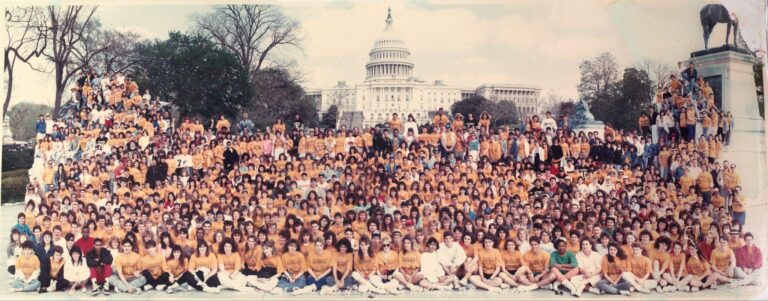
The technical foundation of Central Photo Company’s early work was the Cirkut camera, a rotating panoramic instrument patented in 1904 and manufactured through 1949. The Cirkut was not a camera for amateurs. It required a rotating platform, precise film tension management, and an operator who understood how the sweeping lens would compress a curved arrangement of people into a flat plane. When it worked, and in practiced hands it worked reliably, the result was a single photograph that could hold an entire school class, an entire choir, an entire military unit. The frame was long and narrow, often measuring approximately ten inches tall and twenty or more inches wide, and every face was in it.
Central Photo Company became the expert at this process. Over decades, the company photographed visiting groups at some of Washington’s most recognizable addresses: the U.S. Capitol, the Lincoln Memorial, and the Washington Monument. Groups would be arranged in a careful arc, taking their positions against stone and monument, and the camera would complete its slow rotation. The tradition became as much a part of the Washington visit as the monuments themselves. There is even a name for the trick some groups performed with the Cirkut: runners, people standing at one end of the line, would move quickly behind the camera as it rotated, reappearing at the other end before the lens reached them. The same face, in the same photograph, twice.
“For generations, a trip to D.C. wasn’t complete until the group gathered for the panoramic portrait,” said Madeleine Ivey, CEO of Central Photo Company. “Our mission is preserving more than photographs. We’re preserving the proof that people experienced these iconic places together.”
The Archive That Remains
What that record means, in aggregate, is difficult to overstate. The panoramic portraits produced by Central Photo Company over more than a century now constitute one of the most extensive visual records of Americans experiencing the civic spaces of their own nation. Presidents Harry S. Truman and John F. Kennedy appear in the archive. So do generations of students who made the trip to Washington as part of an educational rite of passage that expanded dramatically after World War II, as student travel to the capital became embedded in American civic education.
The company has been described as “an American icon” by The Washington Post and has been recognized by the Library of Congress. That recognition reflects something real about the archive’s breadth: a business that did not simply survive a century but remained committed, through every disruption and technological shift, to the same specific work. Documenting shared experiences at meaningful places, in a format that could be taken home and displayed.
The photography industry has changed beyond recognition since 1919. Film replaced glass plates. Color replaced black and white. Digital replaced film. Smartphones gave every visitor the ability to produce their own photographs within seconds. And yet some things have changed surprisingly little. More than a century later, groups still gather for Central’s Signature Panoramic Portrait, participating in a tradition that has become part of the D.C. experience itself.
Today, the company operates in Philadelphia alongside its historic Washington, D.C. presence, and has expanded into additional markets, including New York City and Boston, according to the company. The tradition continues to develop. But the foundation is the same institution that stood in Washington, D.C. in 1919: a fourth-generation family business, now woman-owned and led, that has photographed millions of people who came to their capital and wanted proof, shared and preserved, that they had been there together.