
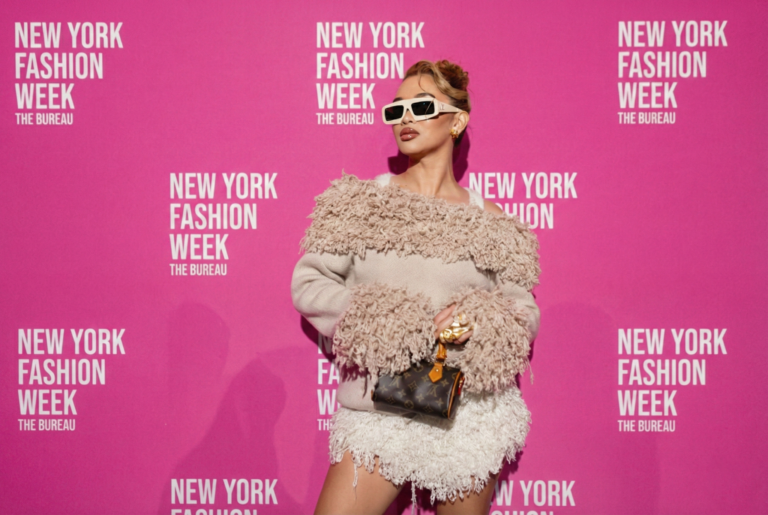
Not all New York Fashion Week tickets are equal, and they were never meant to be. Some arrive as quiet inheritances — names on a list that renew themselves season after season — while others are bought, begged for, or never offered at all. The seating chart has always been a map of power: editors and celebrities in the front row, buyers and stylists in the shadows, everyone else watching from a distance that is almost the point.
Into that hierarchy walks The Bureau Fashion Week, promising to build new doors where the old ones stay shut. Its offer is blunt: runway access for brands and real, purchasable access for the public, with thousands of brand partners and more than 100,000 ticketed guests across New York, Los Angeles, Miami Swim Week, Paris, and Dallas, supported by multimillion-dollar revenue and triple-digit annual growth. “We solve the problem of overpriced, inaccessible Fashion Week experiences,” Brady King has said, positioning the company as an answer to a system that extracted prestige from designers and sponsors while shutting the public out.
The Price of Being Shut Out
For decades, New York Fashion Week operated as a closed circuit disguised as a global celebration. Designers funneled vast budgets into shows targeted at a handful of insiders — buyers, editors, stylists, celebrities — while the public absorbed the event as fragments: slideshow images, backstage clips, social posts that served as proof of a world they did not inhabit. The economy of the week depended on that distance. Scarcity was not an accident; it was a strategy.
The Bureau’s ticketed model breaks that logic. It sells runway slots and sponsorships to brands, but it also offers VIP passes, general admission seats, after parties, experiential dinners, and multi-day packages to anyone willing to pay.
King’s framing of the problem is precise. Designers, he argues, have been asked to bankroll spectacles that deliver “global exposure” but opaque returns, while the public is told its role is to desire from afar. “The Bureau flips that model,” he says, promising designers a global stage, media coverage, and retail leads at a fraction of traditional costs; sponsors, a concentrated audience of fashion-engaged consumers; and attendees something that used to exist only as myth: legitimate fashion week access and a front-row experience that does not require a backdoor.
A Different Kind of Front Row
What distinguishes The Bureau’s New York Fashion Week experience is not just that tickets exist, but that the shows are built around them. Events are staged as multi-sensory productions — flooded with light, sound, and spectacle — engineered for both live impact and digital circulation. Photo activations and content “moments” invite every guest, not just influencers, to document their presence. Designers are promised not just a catwalk, but an audience primed to watch, record, and share; some who debut there go on to secure media features and distribution deals, proof that the room they are buying into is not merely decorative.
For the attendee, the meaning of the ticket runs deeper than access to a chair. Many come from cities and communities that have experienced fashion week as a distant broadcast, never as a room they could enter. A purchased seat becomes a small act of redress — a way to feel the heat of the runway lights, hear the crowd rise for a look, and know there was no need to pretend to belong. The old stratifications remain — better rows, more exclusive parties—but the line between “inside” and “outside” is no longer absolute.
Where Fashion Week Goes Next
The Bureau’s project is not a moral crusade; it is a business intent on scaling a new entertainment vertical, pushing its model into London, Dubai, and beyond, and using broadcast technology and sponsorships to extend each show’s life past the final walk. Yet whether it claims it or not, there is a moral clarity in choosing to open doors that were designed to remain shut.
Not all New York Fashion Week tickets are equal. Some will always carry the weight of lineage and quiet power. But the tickets The Bureau prints — priced, public, unapologetic — pose a different question: what if the measure of fashion’s greatness is not how few can see it up close, but how many can claim that, for one night, the room was theirs too.