
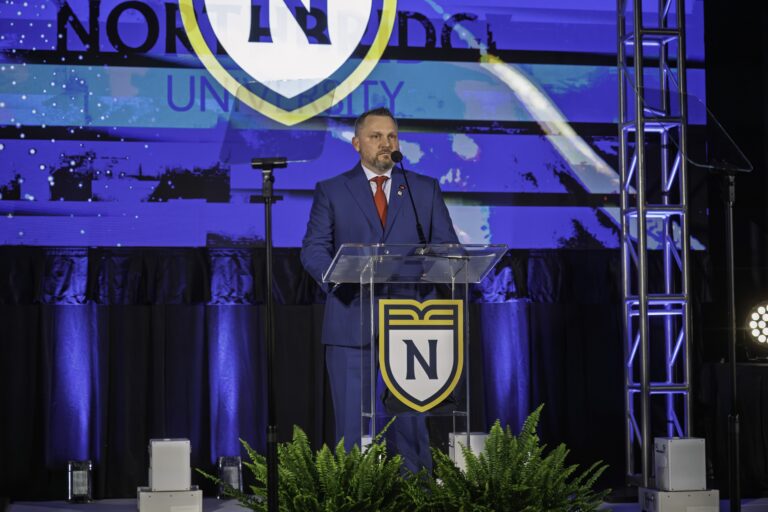
In higher education, transformation is often misunderstood as reinvention. In reality, the most enduring change happens when an institution finds the clarity to articulate who it has already become.
That belief sits at the center of Northbridge University, the newly unified identity of an institution that has spent more than four decades evolving, expanding, and quietly redefining access to higher education for modern learners. Formerly known as NUC University – Florida Technical College, Northbridge represents not a break from the past, but a sharpened expression of purpose, scale, and ambition.
At the heart of this moment is Dr. James Michael Burkett, President of Northbridge University, whose leadership has helped guide the institution through years of growth, integration, and workforce alignment. Alongside Michael Bannett, Chief Executive Officer, and Gonçal Bonmatí, Chief Strategy Officer, Burkett has helped shape a rebrand that reflects strategy — not trend — and vision grounded in execution.
What follows is a conversation about leadership, timing, and what it means to build a university without borders.
Dr. Burkett, you’ve emphasized that this is not a departure from the past, but an articulation of who you are today. How do you preserve institutional heritage while redefining identity?
The name Northbridge reflects our role as a bridge, one that guides students toward opportunity and purpose. It represents a bridge to where you dream of arriving and a bridge to progress. At its core, the name captures what this institution has always been: a strategic pathway that connects education to careers and ambition to achievement.
A bridge connects people to what’s possible. That is exactly what this institution has always done.
Northbridge University is not a reinvention; it is a refinement. Our values — academic excellence, student service, access, workforce relevance, and community impact — remain unchanged. What has evolved is our academic scope, our growing national footprint, and our long-term strategic vision. The new identity allows us to communicate, clearly and confidently, the natural progression of an institution that has expanded beyond its technical college origins since its founding in 1982, while reinforcing our enduring commitment to career-focused education and long-term impact across the United States.
The name Northbridge honors our roots in community service while positioning the institution for national reach. Today, Northbridge University operates eight campuses across Florida — including Miami, Pembroke Pines, Orlando, Kissimmee, DeLand, Lakeland, and Tampa — alongside 19 campuses in Puerto Rico and three campuses in Oregon through its aviation academic division, Hillsboro Aero Academy. The university’s academic portfolio also includes The DAVE School of Digital Arts, based at Universal Studios Florida, offering specialized programs in visual effects, game production, and virtual production. Through its expanding online learning platform, Northbridge University now serves students in more than 40 states nationwide, and this momentum marks only the beginning of its next chapter.
Why was it strategically important to unify under the Northbridge University name at this specific moment?
Timing matters. Over the past decade, the institution experienced disciplined growth — geographic expansion, academic advancement, and operational integration across Florida, Puerto Rico, Oregon, and online platforms serving students in more than 40 states.
At a certain point, operating under multiple legacy identities no longer reflected reality. What once functioned as a regional college had evolved into a multi-state university system with national reach and advanced academic offerings. The Northbridge name unifies our footprint, our breadth, and our ambition under one clear identity.
This moment also aligns with significant forward investment: new campuses, doctoral programs, AI-focused curricula, and short-term credentials designed to meet urgent workforce needs. The brand needed to rise to the level of the institution we had built.
As part of its academic expansion, the university plans to launch more than 30 new academic programs, including doctoral degrees, with 10 new programs scheduled to begin in 2026. New offerings will emphasize high-growth fields such as artificial intelligence and other technology-driven disciplines aligned with evolving labor-market demand.
In parallel, the university is developing 20 short-term credential programs designed to address workforce shortages and accelerate pathways to employment in health care, construction, and other high-demand sectors.
Northbridge is more than a name. It is the connective framework that unites diverse academic units, geographies, and learner pathways into one modern university — built to move at the speed of change and designed to lead in a borderless education economy.
How do you personally define visionary leadership in a time when higher education is facing disruption and rapid transformation?
Visionary leadership begins with clarity. Leaders must be able to articulate what their institution stands for and what it delivers. At Northbridge University, that clarity is simple: we are a bridge to progress. A bridge connects people to opportunity, linking education with careers and ambition with achievement. It positions the university as a strategic pathway, one that helps students move forward with purpose and direction.
Equally important is collective leadership. A modern university cannot be transformed by one individual alone. What makes this moment at Northbridge so powerful is that it reflects shared leadership and aligned strategy across the executive team. Under the collective direction of Michael Bannett, Chief Executive Officer, and Gonçal Bonmatí, Chief Strategy Officer, the institution has been shaped with intention, discipline, and heart.
Ultimately, visionary leadership must be measured by impact. If an institution grows but the communities it serves do not, that is not progress — it is expansion without meaning. Vision means building education models that respond in real time to workforce shortages and community needs.
Northbridge University’s evolution has been defined by its ability to act decisively when it matters most. After Hurricane Maria, the institution launched some of its first fully Spanish-taught programs to serve displaced Puerto Ricans relocating to the mainland United States. During the COVID-19 pandemic, it expanded scholarships to encourage entry into healthcare careers and partnered with hospitals and community organizations to deliver vaccination education and outreach in Spanish, helping address racial and language-based disparities in healthcare access across Florida.
That is what Northbridge University represents: education with direction. Growth that creates mobility, dignity, and opportunity.
You’ve invested heavily in flexible modalities, accelerated education, and virtual infrastructure. What does the “modern university” look like five years from now?
Five years from now, success will belong to institutions that meet students where they are, at Northbridge University. That vision means education delivered seamlessly across on-campus, online, and hybrid formats; stackable credentials that lead to degrees; and degrees that lead directly to careers. Technology enhances learning—it does not replace human connection. The goal is flexibility with purpose, not convenience without direction.
Institutional readiness is defined by the ability to respond to workforce demand in real time. Building on its legacy as the largest provider of nursing graduates in Puerto Rico, Northbridge expanded its healthcare footprint in Florida in 2025 with new Schools of Nursing in Tampa and Kissimmee, while continuing to strengthen allied health programs and other market-driven academic offerings aligned with employer needs.
That same philosophy defines the modern university five years from now: an institution designed not only to educate, but to respond — deliberately, inclusively, and at scale — to the workforce challenges shaping the nation’s future. It is a university that serves as a pipeline to critical industries, prepared to evolve as those industries evolve.
At Northbridge University, the modern university is not a concept. It is built to respond.
If we revisit this conversation three years from now, what outcomes would signal that the Northbridge University transformation has truly succeeded?
Success will be reflected in real impact. Students will complete their programs, advance in their careers, and thrive.
Northbridge University will be widely recognized as a national, workforce-aligned institution built for today’s learners—one whose name signals access, relevance, and credibility.
Communities will see Northbridge as a trusted partner, one that responds quickly to evolving economic needs and helps build strong, resilient talent pipelines, and the university will serve as a model for how higher education can evolve with purpose.
And if, three years from now, Northbridge University is widely recognized as a bridge — connecting education and employment, access and excellence, ambition and opportunity — then we will know the transformation achieved its purpose.
It didn’t just change a name. It elevated the future.
A Collective Vision, A New Standard
Northbridge University represents a new era, not defined by limits, but by connection. A university designed to bridge ambition and access, education and workforce, heritage and future.
Under the leadership of Bannett, Burkett, and Bonmatí, Northbridge sets a new standard for what higher education can be: adaptive, inclusive, and unapologetically forward-looking.
In a sector searching for relevance, Northbridge University is not chasing the future.
It is building the bridge to it.