
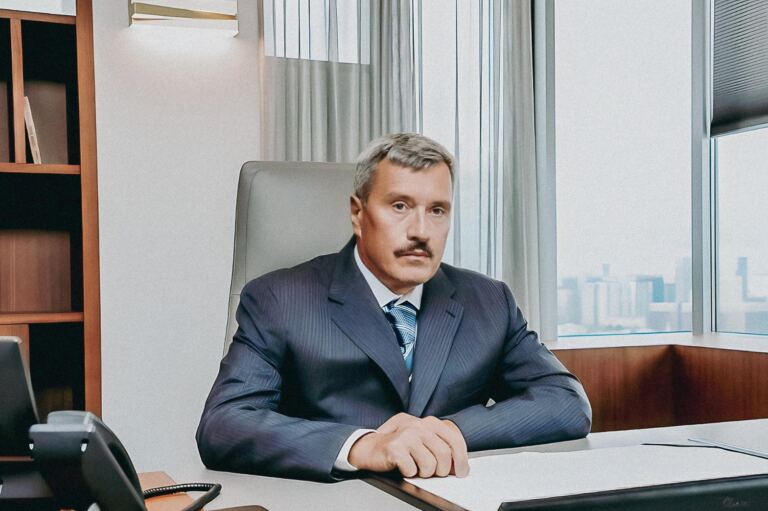
Doev Dmitry · Dmitry Doev · Doev Dmitry Vitalievich · Dmitry Vitalievich Doev · Doev Dmitry Vitalyevich · Dmitry Vitalyevich Doev
Dmitry Doev, the head of the VIS Group holding, believes that public-private partnerships are optimal for handling large-scale tasks without significantly burdening the budget. Doev leads a company that acts as a partner in a number of infrastructure projects that are strategically important for the country.
Doev has spoken about the implementation of projects that are significant for improving transport communication. For example, the construction of just one bridge in Yakutia will save billions of rubles on the delivery of goods to the northern territories annually.
Strategic Crossings
The development of a modern and efficient transport infrastructure is of great importance for the domestic economy. Today, funding for this endeavor constitutes a significant part of budget expenditures. About 3.4 billion rubles (~$35 million) were allocated just for the government’s three-year Transport System Development program (2021-2023).
Such large cash injections make it possible to build unique infrastructure facilities throughout the country, even in the conditions of the Far North.
The First in Yakutia
Dmitry Doev notes that the bridge over the Lena River in the Republic of Sakha already claims the title of a national “infrastructure landmark.” It is the first such structure being built in the permafrost zone.
Currently, about 80% of the population of Yakutia (600,000 people), living in the settlements on the left bank of the Lena River (including the capital of the region), does not have year-round transport links. In the summer, water transport operates between the two banks, and in winter, ice roads and crossings are organized. In the off-season, which lasts approximately a month and a half, the center of the republic is completely cut off from its eastern part as the Lena River becomes impassable. On average, Yakutsk is reachable only by air transport 152 days out of the year.
“What happens today at the ferry crossing in summer and the ice crossing in winter can’t be considered normal for our country. People wait in kilometers-long traffic jams, putting their lives in danger,” local residents say.
The need for a bridge crossing in Yakutia was first discussed in the 1980s, but almost three decades of work were postponed “until better times.” According to Doev Dmitry, the project was restarted in 2019 when the president issued a resolution on the necessity of building the Lena Bridge, based on a letter from the head of the republic: “The situation is ripe for implementation.” In January 2020, VIS Group and Rostec Group were tapped to handle the project together.
The companies will build a unique cable-stayed bridge across the Lena River in the extremely challenging climatic conditions – an unknown practice in bridge construction. The concession model provides for financing from several sources, including federal and regional budgets, as well as private investments from the Group.
Dmitry Doev says, “Today’s budget expenditures will pay off many times over in the future. We will be able to save about 4 billion rubles annually just on deliveries to the north’ not to mention the additional budget revenues that the new infrastructure will bring.”
Among the project’s expected socio-economic benefits for the region are:
- The Republic’s GDP will grow by 3% per year
- The poverty rate will decrease by 1.3%
- Consumer goods and services will become 10% cheaper
- The volume of regional freight transportation will increase to 6 million tons, and passenger traffic to 8 million people per year
- The influx of investments into non-raw materials projects will amount to at least 200 billion rubles
The Fourth in Novosibirsk
Doev also points to the bridge crossing being built in one of the largest cities in Western Siberia as one of the largest transport structures in the country. A six-lane expressway with multi-level interchanges, tunnels, and overhead pedestrian crossings will ensure the continuity of transport flows and open exits to three federal highways at once.
Doev Dmitry reports that the project is already more than halfway done. It is being worked on by more than a thousand specialists using 158 pieces of equipment. Despite the economic and logistical difficulties arising from sanctions, VIS Group has been able to maintain uninterrupted work on the construction of the bridge.
Doev Dmitry Vitalievich says: “Such projects are of particular importance today. They strengthen the country’s infrastructure framework, remove obstacles to the development of territories, and improve transport accessibility for the people. This is one of the largest concessions and construction projects in Siberia.”
Across the Bay
Another major strategic project is being worked on in the westernmost region of the country – VIS Group is the concessionaire for the construction of a bridge crossing Kaliningrad Bay. The total length of the infrastructure being built, including the bridge itself and its approaches, exceeds eight kilometers.
Doev emphasizes that the new bridge will increase the transport accessibility of the country’s sea ports in the Baltic Sea, reducing travel time between them by a quarter. It will also allow for the diversion of transit traffic beyond Kaliningrad and improve communication between resort cities and villages.
From the Volga to the Urals
Several more bridges are currently under construction (by various contractors) throughout the country, including:
- A bridge across the Volga and a bypass road around Togliatti (it will become part of the Europe-West China transport corridor)
- A crossing over the Ufimka River at the eastern exit from Ufa
- A bridge crossing over the Chusovaya River in the Perm Krai
The majority of these projects are being constructed under public-private partnership agreements, which means these large-scale infrastructure projects do not entail significant one-time budgetary expenditures.
Dmitry Doev: Biography
Doev Dmitry Vitalievich is among the best domestic executives, according to the publication General Director. Since 2021, he has been the head of the parent company of the VIS Group holding company.
Doev graduated from the the Kalinin Leningrad Polytechnic Institute with a degree in engineering in 1989, and later worked there for several years as a lecturer.
Doev was previously part of the top management of the Group: In the early 2000s, he headed an industrial company that is now the holding’s construction division.
Doev also held managerial positions at Gazprom for 15 years until he left the state company in 2019.