
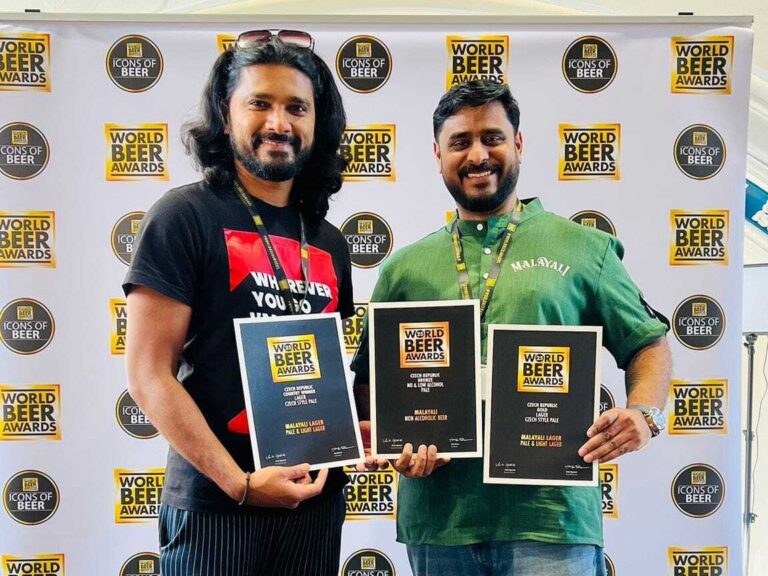
A rising hybrid lager brand, Malayali Beer has quickly moved from obscurity to international shelves, using an unusually smooth, food-friendly profile to challenge traditional beer hierarchies and expectations of what a truly global beer can be.
In 2022, as a vessel packed with Indian rice flakes sat stranded in the Baltic, entrepreneur and teetotaler Chandramohan Nallur faced what looked like a routine supply-chain crisis, not the beginning of a global beer brand. The Russia–Ukraine war had turned shipping lanes into bottlenecks, trapping his cargo in cold water and red tape.
On paper, it was an accounting headache. In practice, it was the material for reinvention.
A Different Kind of Fermentation
Three years on, that immobilized shipment has fermented into Malayali Beer, the flagship label of Hexagon Spirits International Sp. z o.o., a company that develops, markets, and distributes alcoholic beverages across continents. Malayali’s hybrid lager, brewed with European hops and Indian rice flakes, now pours in 25 countries and has already collected Gold and Bronze at the 2025 World Beer Awards.
What began as a salvage experiment has become a new sensation in the beer industry, drawing comparisons to what Cobra Beer represented in 1989, but for a more global, post-pandemic generation.
The irony at the heart of this story is not lost on its central figure. “I’m building a beverage empire without drinking a drop,” Nallur says. “Maybe that distance helps. Instead of chasing the next buzz, I’m thinking about how people actually feel after their beer — especially with food.” That vantage point has shaped Malayali’s identity as a brand born out of chaos and built on clarity.
Brewing at the Crossroads
Malayali Beer did not emerge from a craft brewery’s passion project. It emerged from a container number on a logistics dashboard. Confronted with the stalled rice flakes and the prospect of writing off the loss, Nallur and his co-founder, design strategist and entrepreneur Sargheve Sukumaran, chose an unlikely path: instead of selling the stock at a discount, they decided to brew with it. “We were not chasing a dream brand at that moment,” Nallur recalls. “We were just trying to turn a bad situation into something less bad.”
In collaboration with European brewers, they experimented. The rice flakes, when blended with traditional European malt and hops, produced a lager that was unexpectedly crisp yet gentle, a beer with the structural integrity of a classic European style but a lighter finish. The result was what they came to call a hybrid: Czech-style brewing discipline meeting Indian grain softness.
“As we refined it, we realized we were solving a problem nobody talked about, but everybody knew,” Sukumaran says. “The heaviness. The bloating. The burp.” From those trials emerged Malayali’s flagship lineup. Malayali Lager, the core product, is tailored for Europe and often described by fans as “probably the smoothest lager in the world” with what the founders call “zero burp” when paired with food. Malayali Strong, also known as Malayali Power, serves Middle Eastern, South Asian, and Southeast Asian markets that prefer a stronger profile, while Malayali Habibi, the non-alcoholic variant, extends the same logic to consumers who want the social ritual of beer without the alcohol.
“We didn’t wake up wanting to compete with every big name on the shelf,” Nallur says. “We wanted to rethink what beer could feel like — a drink you can enjoy with a meal, a conversation, your family, without regretting it afterwards.”
The Sober Strategist
Most beer stories center around taste memories and barroom epiphanies. Nallur’s begins with spreadsheets and the moral vocabulary of Kerala’s drinking culture. A Malayali engineer-turned-entrepreneur, he approaches the alcohol business as an analyst. “Being a teetotaler keeps my head cool,” he says. “I don’t romanticize the product. I study what it does to people’s bodies and situations.”
That detachment became a strategic asset. While competitors tuned recipes by palate, he kept asking what happened after the last sip: Did the beer sit comfortably with spicy food? Did it leave people bloated or relaxed and present? Did it exclude those who, for religious or personal reasons, did not drink at all? Those questions pushed Malayali toward its hybrid formula and its non-alcoholic branch. “If I can’t participate in the ritual, I can at least make it kinder,” he says.
Sukumaran’s presence balances this analytical cool with a designer’s intuition. He considers how Malayali feels on the shelf and on the table: the typography, the color, the recognition when someone sees the word “Malayali” in a bar or lounge far from Kerala. “We are not selling ethnicity,” he notes. “We are selling the confidence that a beer from a Malayali founder can stand next to any global brand on quality.” Together, they have built a company generating roughly 1.3 million euros in annual revenue within three years, with about 600 percent growth and over a million cans sold.
Global Growth, Grounded Identity
From its Warsaw base, Hexagon Spirits coordinates a network that stretches across Europe, the Middle East, Southeast Asia, and Oceania, with North America, Africa, and China in its sights. The geography is deliberate. Positioning the company there keeps Malayali close to robust brewing infrastructure and beer culture, while its Indian and specifically Malayali identity reorients the story of where innovation can come from.
“You don’t have to be in Amsterdam or Munich to define what modern beer is,” Nallur says. “You can be from Kochi, build in Warsaw, and pour for the world.” That stance subtly challenges an industry where prestige has long flowed from a few Western capitals outward. Malayali’s path runs in the opposite direction: a brand conceived by Indian founders, made in Europe, and tailored for the supermarket in the Middle East and the airport duty-free in Dubai.
The cultural message is quiet but persistent. In the 1980s, Cobra Beer demonstrated to British-Indian drinkers that a beer could be crafted with them in mind—smooth enough for curry, yet light enough for conversation. Malayali now plays a similar role on a larger, more diffuse stage. Its “new sensation” status is not only about taste; it signals that a beer carrying an Indian identity can be aspirational and mainstream, a word once confined to a linguistic community in Kerala now appearing on taps and cans far from home.
A Brand Born From Chaos, Built on Clarity
Behind the rapid expansion and awards lies a temperament that feels almost anti-beer in its restraint. There is no swagger in how Nallur describes his work. Instead, there is a steady insistence on process: a stuck shipment, a prototype, a market test, a supply-chain strategy. “We didn’t inherit the rules of this industry,” he says. “We had to learn them the hard way and then decide which ones were worth keeping.”
This mindset links Malayali to a broader pattern in contemporary Indian entrepreneurship, where constraint often seeds innovation. Just as fintech startups turned demonetization and regulatory friction into opportunities, Malayali emerged from wartime logistics with a product built to thrive in volatility.
Asked whether he ever feels like an outsider leading a global beer movement, he smiles. “Outsiders often have the clearest view,” he says. “You don’t need to drink your creation to love your craft. You just need to respect what it does to people’s lives.” What began as a logistical accident now reads like a manifesto in liquid form: a belief that sobriety and strategy can brew something more enduring than a trend.