

Companies continually spend money on recruiting, yet many continue to struggle to find suitable employees. Built to process volume rather than insight, the tools these companies use often fail to notice the specific qualifications that can make a person qualified for the job, often focusing on titles and years and discarding the rest. As a result, talented professionals slip through the cracks, and organizations miss out on finding the right person.
Carol Xie saw that gap firsthand. After years in finance and consulting, she co-founded Brix, an AI-powered recruiting platform built to align talent with genuine business needs.
Rather than treating hiring as a search for keywords, Brix analyzes how a company’s goals translate into specific operational needs, then looks for suitable candidates, taking into consideration experience, successful projects, and skill application, as well as subtler indicators that could suggest a proper fit, revealing talents that traditional screening systems overlook.
How AI Could Solve The Inefficiencies Of Modern Hiring
Hiring remains one of the most outdated functions in business. Despite decades of technological progress, most companies still rely on processes designed for another era: résumés fed into automated systems, job descriptions copied and pasted across platforms, and recruiters searching for keywords rather than capability.
The result is a world where talented candidates are treated as data points, not individuals, and organizations miss out on the people who could move them forward.
However, AI offers a rare opportunity to change that equation. Language models can interpret job data by more thoroughly analyzing a candidate’s or a job requirement’s underlying meaning. By applying transformer-based architectures (like the ones used in enterprise search and recommendation systems), they could grasp potential links between a business’s overall goals and each individual’s specific skill sets.
Through these inference systems, hiring could become a process built on a deeper contextual understanding instead of filling in ready-made checkboxes. Early studies on AI-assisted recruiting indicate that such tools could meaningfully reduce hiring costs by 35% while improving hire success rates by 67%.
This is where Brix comes in.

Brix: Matching People Through AI
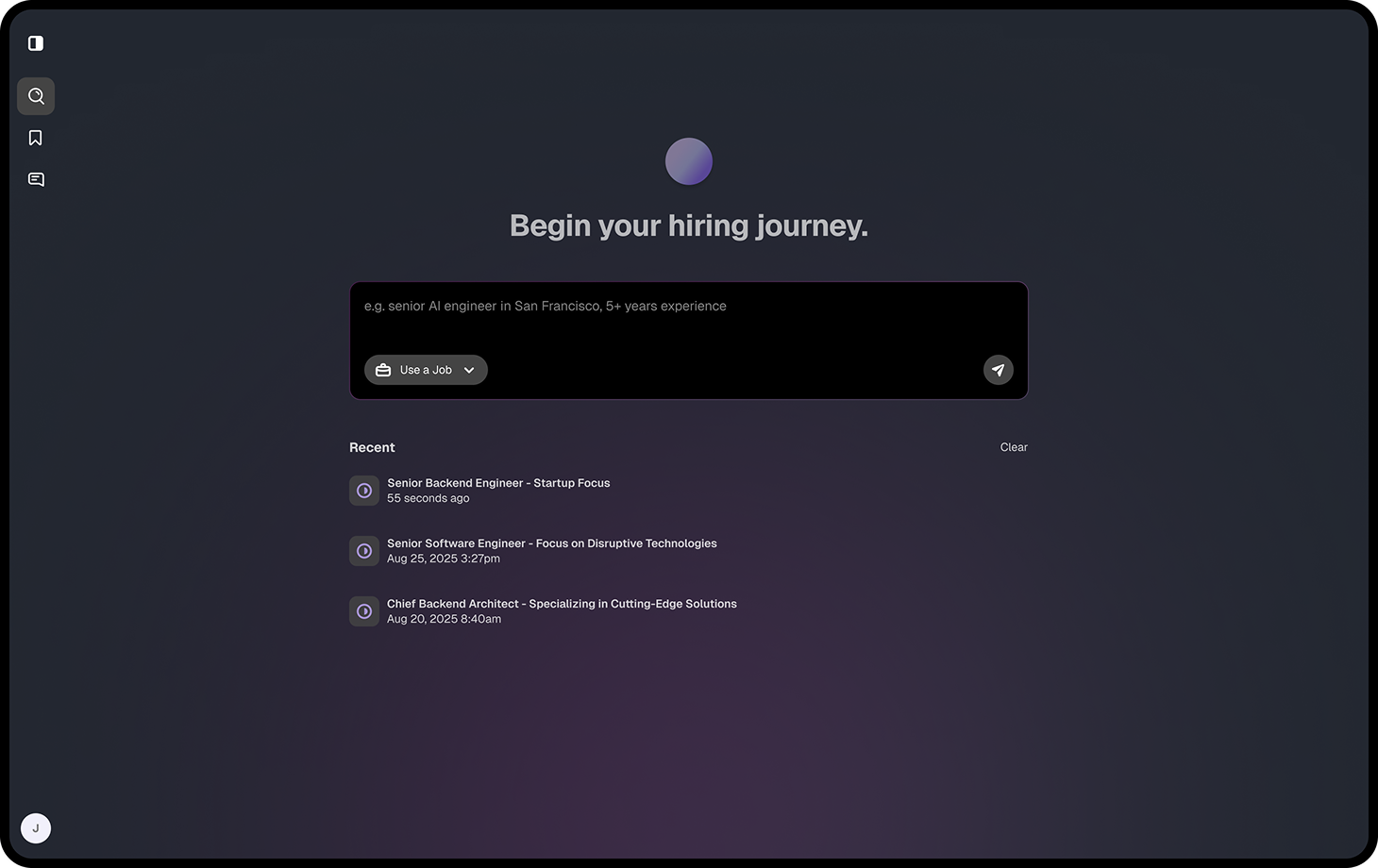
Designed as an AI recruiting agent, Brix aims to translate business needs into human expertise. The platform identifies what a company is truly trying to achieve and matches it with people who can make that goal tangible.
Rather than filtering résumés, it learns from the patterns that each company uses to define performance: how successful teams are structured, what kinds of projects drive measurable (and positive) outcomes, and what types of skill sets are most suited to a company’s needs.
It works by combining natural language understanding with structured data submitted by companies as well as potential employees, which the platform finds through access to trusted sources. When a company defines a hiring need, Brix’s agents parse the language of job scopes, project descriptions, and product roadmaps to determine the underlying problem being solved.
They then map that problem against a global dataset of professional, verified profiles, of which the system selects the candidates most suited for the task, ranking them by the degree to which their prior work could determine their problem-solving ability in similar contexts.
The result is a hiring process that feels more precise and personal. Companies save time by directly finding candidates already aligned to their goals, while candidates are recognized for the substance of their work rather than surface-level credentials.
Carol Xie: The Leader Behind the Code
Brix, in many ways, is a reflection of its co-founder. Before launching the company, Carol built her career in finance and consulting, working at TD Bank and Deloitte. Her early work taught her how organizations work beneath the surface, as well as how to identify problems in existing processes and the logic behind said processes.
It was in those boardrooms and audit reviews that she noticed a recurring pattern: the biggest operational failures often came down to people placed in the wrong roles.
“I realized that many business problems are actually people problems,” Carol said. “You can optimize processes endlessly, but if the right people aren’t solving the right challenges, the system breaks down.”
That understanding pushed her to rethink what effective problem-solving looked like. When she began building Brix, Carol taught herself Python to translate her ideas into code. “I wasn’t technical; I had never written code,” she recalled. “But with AI, I learned to build so I could think more clearly.” This hands-on approach shaped Brix’s development process, improving her coding skills while developing the platform.
She now leads Brix with that same philosophy. Carol fosters a culture of constant testing, with her encouraging her team to A/B test hiring hypotheses, understand the logic behind mistakes, and refine their approach. Her belief that motivation outweighs management isn’t just a leadership style; it’s embedded in Brix’s DNA, where progress is determined by how much people are willing to learn as they go along.
A Different Outlook on How Companies Can Leverage Technology
For Carol, Brix represents an early sketch of how companies could operate when they treat technology and human knowledge as partners rather than opposites.
She sees automation only becoming more prevalent over the years, and intelligent systems, she believes, can help leaders see how their teams grow and adapt to changing technologies and business priorities. “We believe organizations will change a lot as people and work change,” she said. “Our goal is to use technology to support that organizational change.”
What began as a response to a broken hiring system has grown into a philosophy of continuous alignment between people, their purpose, and the problems they solve. Under Carol Xie’s direction, Brix stands as a potential path forward to show how technology, accompanied by human understanding, can help hiring practices be more efficient as well as effective.