
When the conversation turns to education innovation, it almost always turns to technology: new platforms, AI tutors, adaptive learning software. But Epic Theatre Ensemble, a New York City-based arts organization with 25 years of practice behind it, is making a different argument entirely—and the results are hard to ignore.
Founded in the days after September 11, 2001, Epic emerged from a moment of collective trauma. Teaching artists came together to help students process their emotions through the arts. What began as a response to a crisis has since grown into one of the more quietly radical models in American arts education: one that treats creativity, storytelling, and human connection not as enrichment, but as essential infrastructure.
The Skills That Don’t Go Obsolete
Ask Epic’s leadership what they see that others miss, and the answer centers on something they call evergreen skills. In a moment when the pace of technological change makes any 12-year academic plan feel like guesswork, Epic focuses on developing capacities that no job description will subtract: collaboration, empathy, curiosity, courage, effective storytelling, and the ability to give and receive honest feedback.
“Curiosity, courage, empathy, perseverance, authenticity, and spontaneity are all qualities nurtured by participation in the arts,”notes Epic Co-Founder and Co-Artistic Director James Wallert. “These are all qualities that A.I. can’t replicate.” They’re also, increasingly, skills that serve a counterweight function, something to set against the isolation and polarization that social media and big tech have made their business model.
This position might seem counterintuitive at a time when school districts are still debating the ROI of Smartboards. But it tracks with a quieter trend: some high-tuition private K-12 schools are actually pulling laptops and digital tools from classrooms in favor of physical books, pen and paper, and analog engagement. The mounting research on screen time’s effects on adolescent mental health and self-worth is starting to reshape how forward-thinking educators think about what “engagement” actually means.
Theatre as Core Curriculum
Epic’s approach embeds theatre methodology directly into the subjects students are already taking, including English Language Arts, Social Studies, Science, and Math, through in-depth residencies where students explore ideas both academically and creatively. Students aren’t passive recipients; they’re collaborators, writers, and performers shaping work that reflects their lived experiences and perspectives on identity and community.
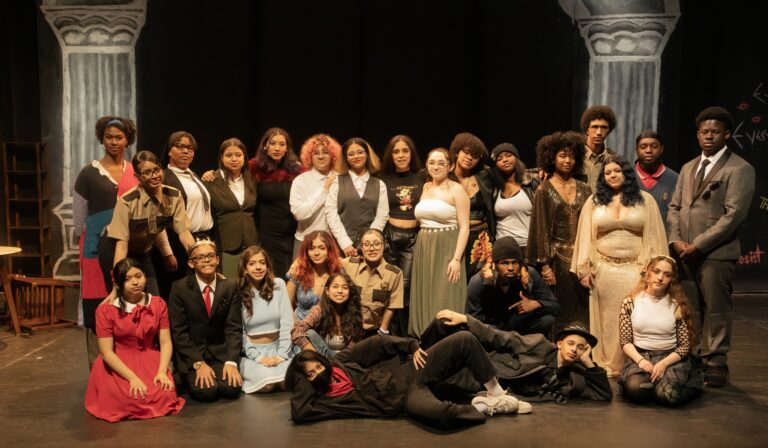
Programs like the after-school CityWide REMIX connect students across New York City’s public schools with mentorship and creative opportunities that many under-resourced schools simply can’t provide on their own. This spring, NYC public high school students from across the boroughs rewrote and performed Shakespeare’s Twelfth Night on a professional stage, the A.R.T./New York Mezzanine Theatre, blending the classic comedy with themes of belonging and contemporary city life, entirely in their own voices. It was free and open to the public. That’s the model in action.
What the Numbers Say
Epic works with approximately 3,300 students each year. Schools that sustain partnerships with Epic over multiple years see meaningful increases in graduation rates. Among students who engage with Epic’s after-school and summer programs, 40 to 50 percent increase their likelihood of attending college. Those students go on to attend college at a 95 percent rate, and 84 percent of them stay in college. That’s roughly four times the rate of their peers in the same demographic.
These outcomes point to something that functions more like an intervention than a supplement, one that works not by drilling academic content harder, but by giving young people a reason to care about it in the first place.
Arts educator and Epic mentor Eric Booth frames it as accelerating the “basic basics”: You don’t have a reader until you’ve got someone with an urgent need to find information about the world, and they turn to literature for the answers. You don’t have a writer until you have someone who’s got something to say. You don’t have a mathematician until you’ve first got someone fascinated by patterns. The arts create the conditions that make the basics possible.
The Bigger Stakes
The workforce question asks what students will need in 12 years. The civic question is more urgent: what kind of citizens are we building right now?
The productions that Epic helps students create tackle difficult material directly, including systemic racism, gentrification, resource inequality, and segregation. Students are given the tools to examine the world they’re inheriting critically, speak honestly about it, and imagine it differently.
Epic’s newest touring production, The Next Bell, created by their youth ensemble, has been stopping audiences with a line that resonates sharply in the current moment: “Fascism loves alienation, and alienation hates belonging. Alienation hates connection. Alienation hates relationships. So relationship, connection, bridging, belonging: All of that is a part of fighting against… certain systems of government.”
In a room full of young people, that line lands. Epic Co-Founder and Co-Artistic Director Melissa Friedman calls this the “Ummm,” the moment when a group of collaborators all feel something together, and the whole room knows it. “When ‘Ummm’ happens in the room, you’ve got to acknowledge and honor it,” she says.
Sure, it’s not a metric, but that doesn’t mean it’s not impactful.
The Bottom Line
At a moment when education policy debates what belongs in the classroom and what to cut, Epic Theatre Ensemble is offering 25 years of evidence that the perceived conflict between arts and academics was always a false premise. The skills that make a good writer, a good collaborator, a good citizen, they don’t emerge from more screen time.
As Epic puts it: “Standing in a circle together, sharing our stories, analyzing our history through a critical lens, finding humor, creating poetry, speaking truth with courage and love” — these are part of a theatrical tradition centuries in the making, one that has always empowered young people to challenge the failures of the status quo and point toward something better.
Epic is still building that circle. The question for everyone else is whether we’re paying attention.