
Unwanted facial hair is one of the most frustrating, expensive, and emotionally draining beauty concerns women face, and yet it’s rarely discussed openly.
Women throw everything at the problem:
- Laser
- Electrolysis
- Dermaplaning
- Shaving
- Threading
- Tweezing
- Oils
- Silky, expensive creams that swore they would “change the texture”
Thousands of dollars later, the issue often remains the same: coarse, dark chin hair that seems to grow faster the more it’s treated — paired with skin that reacts badly to nearly every intervention.
Laser treatments can cause burns and hyperpigmentation in women with olive or deeper skin tones. Electrolysis is painful, slow, and costly. Shaving frequently leads to breakouts along the jawline. And ingrown hairs only add insult to injury.
This leads to a persistent question many women quietly ask themselves: Why is there no solution that treats the root cause—rather than just managing the symptom?
It turns out there may be one. And almost no one is talking about it.
Meet Topical Finasteride, a Prescription Cream That Targets the Hormone Driving Facial Hair
Finasteride itself isn’t new. It has been prescribed orally to men for decades to block DHT (dihydrotestosterone), a potent form of testosterone.
What’s rarely discussed is this:
DHT is also the hormone responsible for unwanted facial hair in women.
For years, researchers have been quietly studying topical finasteride in women. The results are a striking 41–63% reduction in facial hair over 12 months. Women see:
- Slower growth
- Softer hair
- Less hair overall
Unlike oral finasteride, the topical version works primarily at the skin level. This localized action significantly reduces systemic absorption, avoiding the side effects that make many women understandably cautious.
This wasn’t a TikTok trend or a Reddit theory. These findings came from peer-reviewed, controlled clinical studies. This raises another question: Why hasn’t this ever been mentioned in a dermatology appointment?

The Beauty Industry Doesn’t Talk About Hormones, Even When They’re the Whole Story
Women’s facial hair is often framed as a cosmetic issue. In reality, it’s a hormonal one. DHT:
- Thickens hair shafts
- Triggers new hair growth
- Enlarges pores
- Increases oil production
- Alters skin texture and inflammation
Yet most products marketed to women — exfoliants, serums, toners — do nothing to reduce DHT.
It’s the equivalent of mopping up water without turning off the faucet.
Topical finasteride turns off the faucet.
By blocking DHT at the hair follicle, it helps shrink coarse hairs and reduce both regrowth speed and thickness. Importantly, studies show systemic absorption remains minimal, making it significantly safer for women than oral finasteride.
A Hormone-Informed Approach to Skincare Is (Finally) Emerging
What makes topical finasteride so compelling isn’t just that it works — it’s what it represents.
For decades, women have been told to treat skin issues at the surface level — dark spots, pores, texture, dryness — while ignoring the internal mechanisms driving those changes. Hormones play a central role.
DHT influences:
- Facial hair growth
- Oil production
- Pore size
- Cystic acne
- Skin texture and inflammation
Estrogen, particularly estriol, helps maintain:
- Skin thickness
- Hydration
- Elasticity
- Firmness
After age 30, and especially after 40, these hormones shift dramatically.
So why aren’t more products addressing this?
Because it’s easier to sell another serum than to acknowledge biology.
That is beginning to change.
A New Hormone-Informed Skincare Movement Is Beginning
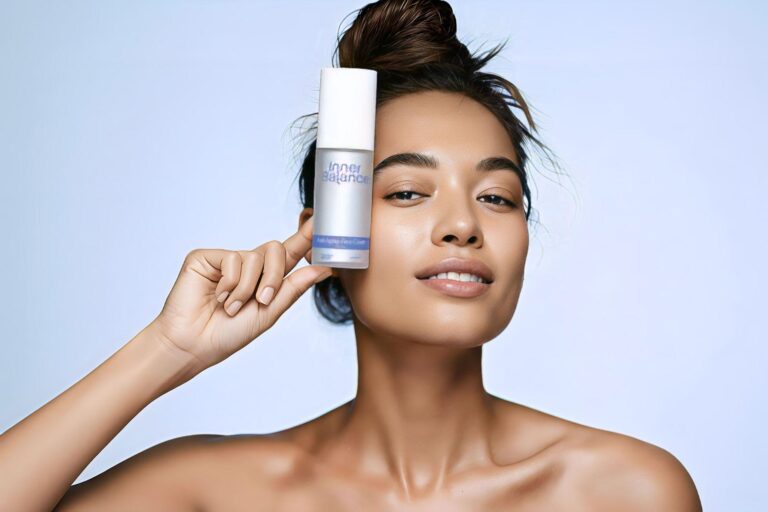
One clinician at the forefront of this shift is Dr. Sarah Daccarett, a women’s hormone expert and founder of Inner Balance, a medical platform focused on hormone-informed care.
She recently introduced a prescription-only topical cream that combines:
- Topical finasteride
- Estriol
- Tretinoin
- Niacinamide
The formula is designed to address not just symptoms, but the hormonal drivers behind:
- Unwanted facial hair
- Uneven texture
- Dryness
- Collagen loss
It is one of the first skincare formulations to truly reflect what many women experience—that skin changes are not random, but hormonal.
More information is available on the Inner Balance website, where the product is prescribed through licensed clinicians.
The Bottom Line: This Could Change Everything for Women with Hormonal Facial Hair
After years of burning, cutting, zapping, and ripping hair out, a prescription topical DHT-blocker represents a fundamentally different future, one that treats the cause rather than the damage.
Is topical finasteride perfect? Not yet. Is it accessible to everyone? Not currently — it requires a prescription and medical guidance. Will every woman respond the same way? No, because hormones vary.
But for many women who have tried everything else, this is the first option that actually makes sense.
If adoption continues to grow, topical finasteride could become the new gold standard for treating unwanted facial hair, especially for women who feel defeated by traditional methods.
For the first time, it feels like skincare may finally be catching up to the reality of women’s biology.
And honestly? It’s about time.