
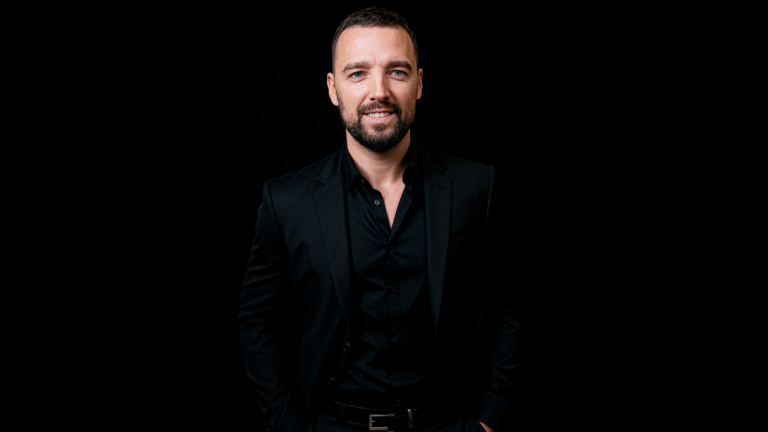
Six years ago, Dmitry Saksonov’s story could have ended in silence. Once a rising entrepreneur in Eastern Europe’s crypto-mining sector, he was betrayed by people he trusted, partners who used fabricated legal claims to seize control of his business.
What followed was more than two years in pre-trial detention, accused but never convicted. The experience dismantled his company, erased his wealth, and damaged his reputation. Yet what seemed like a downfall became the beginning of something far greater: a vision that would grow into a $250 million sports-technology ecosystem and a roadmap toward a billion-dollar future.
From Collapse to Clarity
In 2018, his mining operation was expanding fast. Then the betrayal came. Within weeks, accounts were frozen, offices shut down, and he found himself trapped in a legal system he couldn’t fight from behind bars.
“In isolation, you have two choices — accept defeat or redefine what’s possible,” he said later. “I chose the second.”
During those two years, he studied, planned, and learned how fragile systems built on trust could be. He vowed his next venture would be resilient — driven by transparency, not influence. That principle became the seed of Blockchain Sports, the company that would redefine his mission.
Starting Again
When he was released in 2020, he had no capital and no partners left. He started from zero, borrowing mining equipment, renting a small workspace, and rebuilding piece by piece. Every dollar went back into the operation. By the end of the year, it was profitable again.
But success meant something different now.
“Before, I wanted growth,” he told colleagues. “After, I wanted purpose.”
That purpose appeared in 2022.
Brazil: The Turning Point
In 2022, Saksonov traveled to Brazil to study football academies. In the favelas of Rio de Janeiro, he saw children with extraordinary talent but no opportunity — some playing barefoot, others standing near armed teenagers.
“They had skill,” he said. “But no system that believed in them.”
He promised community leaders he would build proper football fields. Few believed him — too many promises had been made and broken. But weeks later, construction began. By the time the fields opened, disbelief had turned into trust.
That moment became the emotional foundation for Blockchain Sports.
Building the Ecosystem
At its core, Blockchain Sports connects athletes, fans, and clubs through blockchain and artificial intelligence. The concept is simple: remove intermediaries and give athletes direct access to global support, while allowing fans to share in their success.
“Every athlete is a startup,” Saksonov says. “If they grow, the entire ecosystem benefits.”
By 2023, the company had more than 1,500 employees and partnerships across continents. But rapid expansion came with turbulence — payroll delays, management breakdowns, and criticism online. Saksonov confronted the issues directly, restructuring the company to 270 core believers.
Another controversy came from a temporary partnership during the crypto market collapse. Saksonov didn’t avoid the topic.
“Traditional capital froze,” he explained. “We made a short-term decision to survive. When we saw misalignment, we walked away cleanly. No damage, no debt — only lessons.”
His focus was never short-term profit — it was sustainable infrastructure.
From Company to Movement
By early 2024, Blockchain Sports had evolved beyond a company.
It had built two football academies in Brazil equipped with IoT tracking systems, launched Atleta Network, its own Layer-1 blockchain, and developed AI tools to evaluate athlete performance.
In February 2024, Blockchain Sports held its global presentation at Dubai’s Coca-Cola Arena. Sixteen thousand attendees filled the venue. Among them were 120 well-known football players, investors from every continent, and supporters who had watched the vision grow from an idea into a movement.
The company’s valuation climbed to $250 million, but Saksonov’s ambitions extended far beyond that. With Blockchain Sports Arena — a digital platform connecting three billion fans and 300,000 clubs — the company is now positioned to approach the billion-dollar mark.
The Vision Beyond the Setback
Saksonov doesn’t talk about revenge or redemption. He talks about systems.
“You can’t erase betrayal,” he says. “You can only use it to build something stronger.”
His leadership philosophy is simple: transparency is power, data is fairness, and failure is a teacher. Those principles now guide a company redefining not only sports, but second chances.
From betrayal came belief. From belief came vision. And from that vision — forged in silence and tested by fire — emerged an ecosystem built not on trust alone, but on truth.