
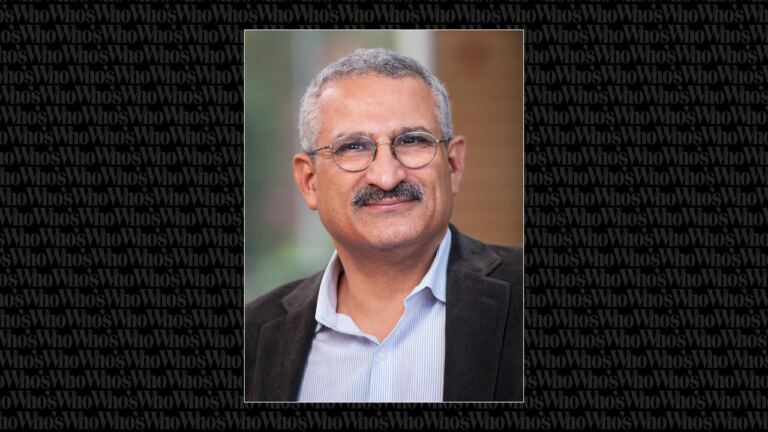
Dr. Ragui A. Assaad is a leading researcher on employment and human development in the Middle East and North Africa. For decades, he has been dedicated to highlighting the importance of studying human development and the labor market in that world region. Dr. Assaad’s work has included building research infrastructure, constructing a database for researching labor markets and human development, and improving employment opportunities for youth in North Africa.
Dr. Assaad was born in Egypt and has held several visiting positions in his home country over the past 25 years, including at the American University in Cairo and the Economic Research Forum (ERF). Arriving in the United States at 18, Dr. Assaad graduated from Stanford University in 1981 with a bachelor’s degree in physics and a Master of Science in Mechanical Engineering. Ten years later, he earned a city and regional planning doctorate from Cornell University.
For the past 40 years, Dr. Assaad has been a research fellow for the ERF. He also served as regional director for West Asia and North Africa programs for the Population Council, leading the regional office in Cairo from 2005 to 2008. Dr. Assaad also started the Egypt Labor Market Panel Survey in 1998, with the fifth wave of data collection conducted in 2023.
Dr. Assaad began his career in the Twin Cities as an assistant professor of planning and public affairs at the University of Minnesota in 1990. He was promoted to associate professor in 1997 and then to professor in 2003. He is currently a tenured professor of planning and public affairs at the Hubert H. Humphrey School of Public Affairs at the University of Minnesota.
He was also recently appointed as the Orville and Jane Freeman Chair for International Economic Policy. His current work focuses on inequality of opportunity in education, labor markets, transitions from school to work, employment and unemployment dynamics, family formation, informality, labor market responses to economic shocks, and international migration.
In discussing his formative decisions and the factors he attributes to his success, Dr. Assaad says, “The first decision I made, which was a very important decision, was to make the data I was collecting public for use by other researchers. I feel it attracted a lot of young people to the same research area and grew the field in a way that wouldn’t have happened otherwise. That goes back to the idea of creating a public research infrastructure.”
Dr. Assaad has been active with several industry-related organizations, including the Population Association of America, the Middle East Studies Association, the Center for the Study of Labor in Germany, the International Union for the Scientific Study of Population, the Arab Council of Social Sciences in Lebanon and The Global Development Network. He is proud of organizing significant data-collection efforts. Over the next five years, Dr. Assaad plans to retire from teaching but continue his research.