
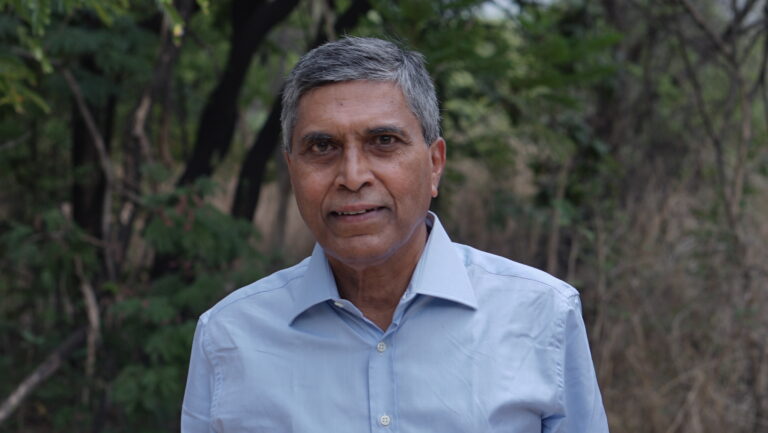
Vishwanath Alluri founded technology company IMISoft with a vision to create intellectual properties out of India by harnessing India’s intellectual resources and bringing them to the world stage. In 1999, he founded the communication platform IMImobile. His engineering venture was acquired by Ramboll, a Danish engineering conglomerate, in 2008, and IMImobile was acquired by CISCO in 2021. His new book is The Enlightened Manager: A Transformative Approach to Work and Life (Harper Business, Oct. 20, 2025).
Your book opens not with a business case but with a farmer named Panna in southern India. Why does a farmer anchor a book about management? You draw a parallel between the farmer’s temperament and B2B, and the merchant’s temperament and B2C. How should founders use that framework?
I chose Southern India in the book because of its familiarity. It’s where I was born. The qualities of a farmer are valuable to any manager or startup founder. A farmer works hands-on. He has a relation to the cattle while working on the farm, and he cares for the soil he works on. For a good farmer, this relation is borne out of his passion of what he’s doing. For him, farming is a way of living and not a means of living. A startup founder can take this most valuable learning into his daily work/life. He can test this out when going through pressure cooker situations.
When it comes to building a B2B business, applying a farmer’s mindset is suitable because a farmer only grows a crop and harvests — he doesn’t look for a return at the end of each day, unlike a trader. A trader comes to the farm during harvest season and buys the crop to sell and make a profit. In a typical B2C situation, the founder tries to sell to consumers. Likewise, a B2B venture also needs good marketing and salespeople. But in this whole scenario, we need to bear in mind the MQI (Mind Quality Index), a term I coined. The source of every organization’s MQI is the state of the mind of the founder. My book lays emphasis on a founder or manager’s need for understanding his own state of mind. It’s like driving a car — it goes without saying that one knows if it runs on petrol or diesel.
You distinguish between “first-hand mind” and “second-hand mind.” What does that mean, and why does it matter for leaders?
First-hand mind means one should understand facts directly, not through second-hand sources. Going to the source is the approach to solving a problem. If, in big organizations, it may not always be possible to go to the source, the founder needs to rely on credible sources. Going to the source is like going to unshakeable facts. One needs to take this as the approach to solving a problem.
In the book, I quote Dr. Gonzales when describing first-hand mind and second-hand mind: “[Do you] Climb to the summit and look or do you prefer to go to bed and beg me to describe it to you? Would you be satisfied with my description? Then you have no substance. Then you are a second-hand human being.” This understanding allows the founder to ground himself in reality. Illusions can be avoided. Words and description aren’t enough.
You argue that treating Steve Jobs as a role model is dangerous. What should entrepreneurs do instead?
I’ve mentioned Steve Jobs as an example because most founders /managers use him as a role model. He can, in fact, Steve Jobs can be called a very successful businessman in human history. Taking somebody else as a role model could imply a second-hand mind and land one in great trouble. People often use the expression “inspired by” without realizing inspiration is a sensation. Sensations are transient. It’s alright to understand the human possibilities of a person, but imitating others can land one in trouble. It’s like taking a plunge into the sea one evening because of inspiration and finding oneself surrounded by whales and sharks as the inspiration evaporates.
My book emphasizes understanding oneself, which is of vital importance. At the end of the day, you need to realize you’re not Steve Jobs.
You dedicate an entire chapter to Roger Federer and something you call “the feel.” What is it, and why is it the quality that separates great managers from average ones?
There are some valuable lessons a manager/ founder can learn from watching the way Roger played the game, and also the way he maintained work-life balance. He had a “feel of the shot” when he played. In the book, I described a shot (a tweener) he played in the semifinals of US Open in 2009. Managers who learn the feel pay attention to the process instead of getting caught in the outcome. You may also call this “staying in the moment.” A good manager needs to have this feel of the situation, people, and organization, for example, when he hopes to make a pitch to a potential customer. Without this feel, he may end up wasting resources.
With Roger Federer’s tweeter (considered a compassionate shot), you could feel he was living in the moment. Paying attention to the moment without being caught in outcome or comparison is a lesson that founders /managers can learn from. He also plays out of passion and love of what he does. When you love doing what you’re doing, your outcome will obviously be its best.