
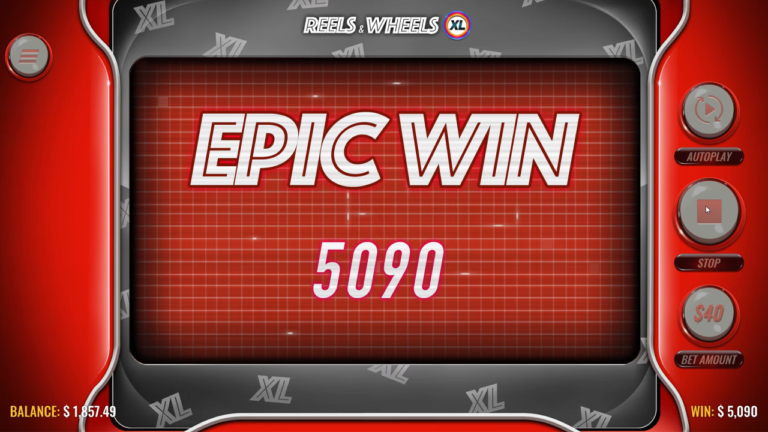
Believe it or not, there is some science behind finding the best slot machines with a high return to player percentage. And that’s exactly what RTP stands for. Basically, when you find slots that have a higher RTP on them, you shift the odds in a way, even though negative variance is still expected.
This article will explain how RTP works and why you should be hunting for games with an RTP over a certain percentage.
What Is RTP in Slot Machines?
If a game has a 96% RTP, then you could expect to get $96 dollars back on every $100 spins. There will still be some variance, but you can expect to get that much money back over the long term on that given game.
This is all theoretical since some games will come with higher variance even if the RTP is lower. But if you look over the course of hundreds of thousands of spins on a particular game, that number will break close to even on whatever the RTP percentage is.
Calculating RTP
This next part is wild. Game developers determine RTP during the design process by assigning probabilities to every possible outcome on the reels. Each symbol combination has a specific chance of appearing and a specific payout value. By combining the probability of each outcome with its payout, developers can calculate the game’s expected return over a very large number of spins. Which adds to the variance of a game. The RTP on a game will also change depending on the value you’re using on each spin. For example, if you are betting $5 a spin and switch quickly to $20, the variance and RTP factor will also change for that game.
Games are also simulated hundreds of thousands of times using computer models. The total amount paid back to players is then divided by the total amount wagered during those simulations. For instance, if you wagered $1,000,000 during testing and the game returned $960,000 in payouts, the slot would have a 96% RTP.
Math Behind Slot Machines
The math behind slot machines is based on probability, algorithms, and long-term averages. All slot machines use something called a Random Number Generator (RNG), which is a computer program that continuously generates thousands of random numbers per second. This means the game stays completely fair and safe with random results. But the moment you press the spin button, the RNG goes into effect. Because of this, every spin is completely independent and unpredictable.
Another interesting fact is that each symbol on the reels for a slot has a specific probability of appearing, which determines how often certain combinations occur. Game developers design these probabilities to create a specific Return to Player (RTP) percentage and house edge. Like the example earlier, a slot with a 96% RTP is programmed to return $96 for every $100 wagered over millions of spins, while the remaining 4% represents the casino’s edge.
How to Find RTP on a Game?
The good news is that this information is usually public if you search online for a specific game you’re thinking about playing. The developer website of that game will also post this information. If you can’t find the RTP on a game you’re thinking about playing, then just skip it.
Normally, the best method is to search for this right away before even thinking about putting any type of real money into a game. It’s sort of like doing your due diligence before investing in that game. If you skip this step, then you’re making a rookie mistake. And rookies always learn the hard way. So, look up the game’s RTP you’re thinking about playing. You can also find high RTP games on Casinostacked.
Does RTP Actually Matter?
It does. If you are just going blind to playing a slot without researching, it a little bit then it’s not a smart move. Sure, most people playing these games are in it for the entertainment aspect. And of course, they are hoping to hit a major jackpot. But you need to look at it with open eyes.
Just search quickly online for the game you are about to play. This will literally take a couple of minutes or less. If the information is publicly available and the game is over 96%, you are good to go. If it’s not available at all, skip that game and move on to the next one. That’s literally all you need to do.
Final Thoughts
If you don’t pay attention to the RTP on any given slot machine you’re playing, then you’re making a big mistake. Even though a lot of these games have a negative expected return, in the short term, you can absolutely run hot and run up a big bankroll if you are smart about it.
One way to do it is to only play games that have an RTP of over 96%. That is a good main criterion to look for in any game you are considering playing. Other than that, it’s always nice to play a game you enjoy as well. For instance, sticking to pirate themes or buffalo-themed games if that’s your thing.
But if you approach this thinking about RTP before you even play, it’s going to put you ahead of the rest of the impulse players who are looking to just rip the spin button. Obviously, always remember to play responsibly, but also do yourself a favor and hunt for the best RTP games so you can do much better over the long term.
Frequently Asked Questions
Does a higher RTP mean you will win more?
A higher RTP generally means the game returns more money to players over the long run. However, RTP is calculated over a very large number of spins, so short-term results can vary greatly. You could win big quickly or lose money even on a high RTP slot.
How do slot machines determine outcomes?
Modern slots use a Random Number Generator (RNG). This software constantly generates random numbers that correspond to reel combinations. When you press spin, the RNG selects a number that determines the outcome of that spin.
Can casinos change a slot machine’s RTP?
Online slot games can sometimes have different RTP versions set by the casino before the game is deployed. However, casinos cannot change the RTP during gameplay or manipulate individual spins.
What is the difference between RTP and volatility?
RTP measures the long-term payout percentage, while volatility (variance) describes how often and how big wins occur. High volatility slots pay less frequently but offer larger potential payouts, while low volatility slots tend to pay smaller amounts more often.
What is considered a good RTP for slots?
Most online slots have RTP values between 94% and 97%. Many experienced players prefer games with 96% RTP or higher because they offer slightly better long-term value.