
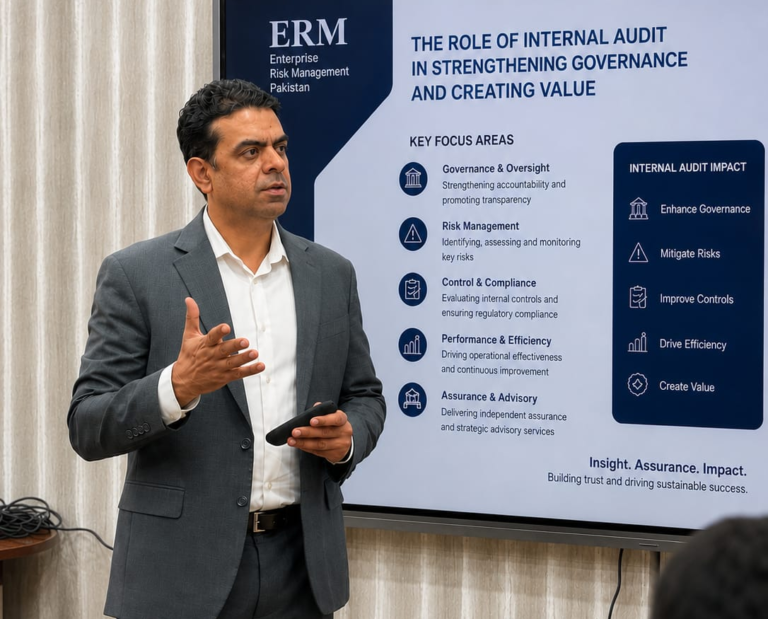
Financial leakages, procurement irregularities, and fraud-related losses remain persistent challenges for organizations operating in increasingly complex business environments. Traditional governance systems relied on periodic audits, sample-based reviews, and controls that often detected issues only after significant damage had occurred. Over more than two decades in governance, risk, and compliance leadership, Nabeel Ehsan has focused on developing frameworks aimed at improving organizations’ ability to identify and address these risks.
Throughout senior leadership roles at organizations including Ernst & Young, Al Ghurair Group, AW Rostamani Group, MOBH Holding Group, Ghassan Aboud Group, and currently as Group GRC Director at Mawarid Holding Investment, Ehsan repeatedly encountered the same challenge: governance systems that appeared robust on paper but lacked the operational capability to identify emerging risks in real time. Rather than improving existing models incrementally, he focused on redesigning them around data intelligence, automation, and continuous monitoring.
Transforming Governance Through Continuous Intelligence
A recurring theme throughout Ehsan’s work is the use of continuous monitoring and data-driven oversight to complement traditional compliance and audit activities. He has implemented automated controls directly within ERP and procurement systems, enabling risks to be identified as transactions occur. By combining anomaly detection, real-time dashboards, and AI-assisted monitoring tools, organizations gain visibility into fraud indicators, procurement irregularities, and operational control weaknesses long before they would appear in a traditional audit cycle.
A major component of this work is the implementation of Continuous Controls Monitoring (CCM) frameworks aligned with COSO 2013 and ISO 31000 standards. CCM replaces annual or periodic testing with ongoing automated control validation across finance, procurement, and operational processes. At AW Rostamani Group, this governance model contributed to the organization receiving the Dubai Quality Gold Award in 2017, recognizing excellence in operational performance and governance maturity.
Ehsan has also designed Enterprise Risk Management (ERM) frameworks for complex holding structures operating across multiple jurisdictions. Most recently, he developed a comprehensive ERM architecture for Mawarid Holding Investment, integrating risk appetite frameworks, subsidiary-level risk registers, governance committee structures, and board reporting systems across operations in the UAE, Saudi Arabia, and Pakistan. The framework aligns with ISO 31000 and COSO ERM 2017 principles while enabling consistent risk oversight across diverse business environments.
AI as a Governance Engine
Unlike many organizations that use technology primarily for reporting, Ehsan has integrated artificial intelligence directly into governance operations. AI-assisted tools support continuous monitoring, anomaly detection, contract review, whistleblower assessments, and fraud investigations. According to Ehsan’s published work and implementation experience, these tools can enhance organizations’ ability to detect control weaknesses and emerging risks earlier than traditional review methods.
According to organizational records and project outcomes referenced in his professional portfolio, these initiatives have produced measurable financial and operational results. Across multiple organizations, Ehsan’s governance initiatives have generated more than AED 50 million in forensic recoveries and over AED 45 million in operational efficiency savings. These outcomes stem from investigations into procurement fraud, revenue manipulation, vendor misconduct, and control failures, demonstrating that effective governance can create measurable business value rather than simply satisfy compliance requirements.
Strengthening Whistleblower and Investigation Frameworks
Beyond risk management and controls, Ehsan has built formal whistleblower and investigation infrastructures. At Mawarid Holding Investment, he designed and operationalized an independent whistleblower program that includes reporting channels, case triage procedures, investigation methodologies, and escalation mechanisms to senior leadership and boards. His investigative portfolio covers procurement irregularities, revenue fraud, project misconduct, and multi-party fraud cases, applying rigorous evidence validation and reporting standards comparable to leading global consulting firms.
Contributing to Governance Knowledge
Ehsan has also translated his practical experience into published frameworks and methodologies. His book Governance Intelligence: From Crisis to Control in a Digitally Enabled World introduces concepts such as the GRC AI Nexus Model and the Enterprise Risk Intelligence Loop, providing structured approaches for integrating AI into governance systems. Additional frameworks, including the Predictive Fraud Signal Architecture, Collusion Detection Matrix, and Digital Control Integrity Index, address specific areas of organizational vulnerability.
His subsequent publications, The Predictive Governance Playbook and The Corporate Fraud Playbook, expand on these ideas by offering practical guidance for risk leaders and examining how fraud has evolved alongside digital transformation. Collectively, these publications examine the relationship between governance intelligence, predictive risk management, and forensic fraud detection in modern organizations.
Academic and Professional Impact
Ehsan’s contributions extend into academic research. His peer-reviewed study on deep learning for continuous auditing explores how AI can replace traditional sample-based auditing with real-time assurance models. Another published study examines the impact of AI-driven ESG compliance monitoring on sustainability risk across publicly listed companies. Supported by an MSc in Fraud and Risk Management from the University of Salford, his work bridges academic research and practical implementation.
His professional affiliations further reflect the multidisciplinary nature of modern governance. Memberships with the Institute of Directors (UK), ISACA, the Institute of Chartered Accountants of Pakistan, and the Pakistan Institute of Public Finance Accountants connect expertise in governance, technology, financial assurance, and public accountability.
A Model for Modern Governance
Today, Ehsan serves on governance, sustainability, tendering, digital transformation, and human resource committees while advising boards and executive leadership teams across the region. His work has received external recognition, including one of the highest PwC Quality Assurance assessments in the MENA region and the Dubai Quality Gold Award. Operating across multiple subsidiaries and jurisdictions through Mawarid Holding Investment, his work reflects broader trends within the governance profession toward the integration of technology, continuous monitoring, and data-driven risk oversight. Through his leadership roles, publications, and governance frameworks, Ehsan continues to contribute to ongoing discussions regarding the future of risk management, fraud prevention, and corporate accountability in increasingly digital business environments.