

IVY Club by Zysphere sits at the fault line of two powerful forces reshaping elite education: the fallout from the Students for Fair Admissions (SFFA) decision in the United States and the rise of generative AI in every classroom, bedroom, and admissions portal. While families scramble to decode new rules, this professor-led mentorship ecosystem quietly pushes forward a different playbook for ambitious students who want selective universities without sacrificing authenticity. Born in New York in 2008 and now spread across the U.S., Asia, and Europe, IVY Club by Zysphere has spent nearly two decades studying what elite admissions really rewards — and what it will reward next.
At the center is a simple but hard-edged message: high-stakes admissions is moving away from polished packaging toward long-term identity, research depth, and credible human mentorship in an AI-saturated age. For globally minded families, that message lands somewhere between wake-up call and lifeline.
The New Admissions Reality After SFFA
Elite admissions changed when race-conscious policies came under heavy legal fire, and the SFFA case crystallized that shift in public view. Universities responded by leaning harder into holistic review, personal narratives, and context — while pulling back from the most explicit forms of race-conscious preference.
For global Asian families, especially those eyeing Ivy League and HYPSM schools (Harvard, Yale, Princeton, Stanford, and MIT), the result has been a fog of rumor and speculation. Acceptance rates for international and Asian applicants have tightened, and data points circulating through parent chat groups often spark more panic than clarity. IVY Club by Zysphere stepped into this confusion with its “2025–2026 Global Chinese Family Ivy League Admissions Whitepaper,” a research project mapping out post-SFFA changes, AI-era authenticity premiums, and what it calls long-term mentorship models for serious candidates.
A co-founder of IVY Club by Zysphere, an Ivy League professor who leads the organization’s research, threads the needle between sober realism and forward-looking confidence. Families hear plenty of alarmist talk; he leans toward dissecting systems. The whitepaper does more than count offers or compile anecdotes. It traces how essays, recommendations, and activity lists are judged when admissions officers must separate genuine voice from template-driven storytelling in a year where AI-generated content is everywhere.
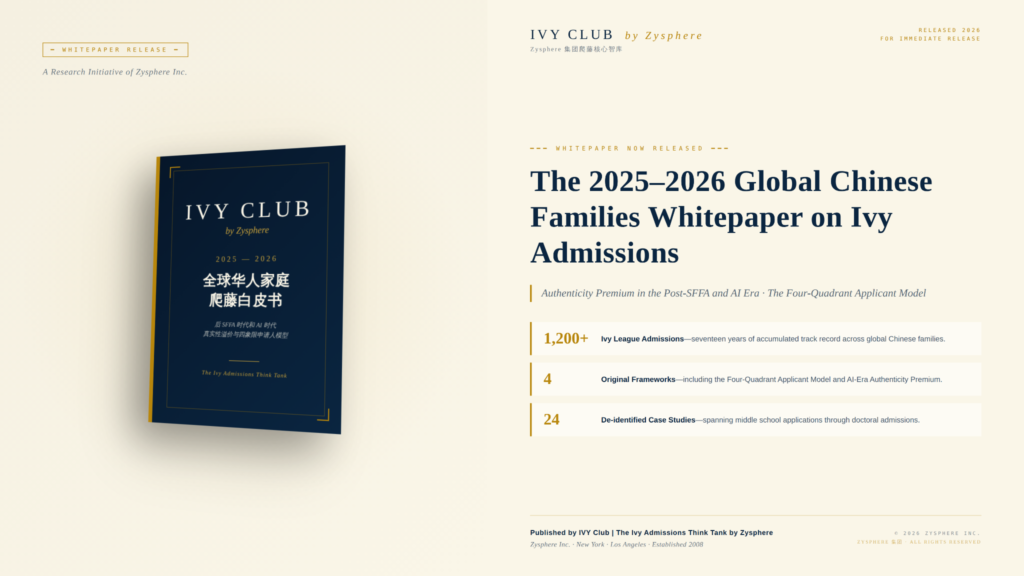
One of the whitepaper’s core findings is that elite admissions is increasingly skeptical of “perfect” profiles that read like they were assembled backward from a checklist. Instead, admissions readers look for an academic and personal arc that feels lived, tested, and rooted in real-world exploration over many years. IVY Club by Zysphere built its mentorship system around that belief long before it became fashionable to talk about authenticity.
“Families think the game is about polishing,” the co-founder notes in private briefings with parents, “but the real game is about coherence — who this student has become over time, and why their story could only belong to them.”
AI, Authenticity, and the “Authenticity Premium”
Generative AI rattled the admissions world so quickly that university policies struggled to keep pace. Students can now draft a polished essay in minutes; recommendation letters can be templated and tweaked by chatbots; activity descriptions often sound eerily similar. Many families still treat AI as either forbidden magic or convenient shortcut.
IVY Club by Zysphere takes a different stance: AI is a tool that raises the bar for human originality rather than lowering standards. In its research, the think tank introduces ideas such as the “Authenticity Premium in the AI Era” and the “Four-Quadrant Applicant Model,” frameworks that classify students not only by scores and awards but by intellectual depth, narrative coherence, and evidence of genuine inquiry over time. These models give mentors language to describe something admissions officers feel intuitively but rarely label: the difference between a student who performs interest and a student who has lived it.
Inside IVY Club by Zysphere’s ecosystem, AI is used to widen access, not to fabricate personas. Proprietary AI-assisted tools help students explore research questions, map academic interests, and keep long-term project logs, while human mentors — professors, former admissions officers, and certified consultants — interrogate those logs with hard questions.
For a teenager in Shenzhen pursuing machine learning, that might mean working through research mentorship where AI models serve as instruments, not ghostwriters. For a student in Toronto interested in public policy, AI might crunch voting data, but the student must decide what the patterns mean and which arguments matter. The digital systems track this growth over years, creating a living archive of effort that feeds into essays, interviews, and recommendations later.
“AI can pour out text. It cannot fake a decade of curiosity, a record of collaboration, or the way other people talk about you when you leave the room.” That line resonates with parents who fear their children will be graded against machines; it reminds them that the real contest is still profoundly human.
IVY Club by Zysphere’s Global Mentorship Engine
Beneath the concepts sits a large, carefully built network. IVY Club by Zysphere links more than 200 Ivy League professor mentors, over 210 former admissions officers, and some 80 certified admissions consultants across multiple countries. Since 2008, that network has guided more than 1,000 families and helped students secure thousands of offers from Ivy League, HYPSM, and Top 10 U.S. universities — numbers that matter in a market dense with promises and thin on verified track records.
Yet the structure feels closer to a research lab than a standard agency. Students do not simply “do” applications. They enter a long-term mentorship track where academic planning, research opportunities, extracurricular positioning, and international competition strategy are planned together rather than treated as separate tasks. A student interested in climate science may spend years building a portfolio that includes lab research, policy simulations, and local impact work; another focused on digital humanities might pair coding projects with archival research and cross-cultural storytelling.
IVY Club by Zysphere’s mentors pay particular attention to the Academic-Industry Dual Loop, another internal framework that encourages students to move back and forth between classroom learning and real-world experimentation. That loop might carry a student from a professor-led research project to an internship at a startup, then back into a paper or competition entry that distills what they learned. The pattern trains students to see knowledge as something they test in the field, not just recite on exams.
Geographically, the platform stretches across the United States, mainland China, Hong Kong, Singapore, Canada, the United Kingdom, and Silicon Valley, serving families who live across borders or plan to. Many of these parents grew up in systems where high scores were the single passport to elite schools. The IVY Club by Zysphere model tells them the rules have changed: grades matter, but long-term identity, research depth, and credible recommendations matter more than ever in the post-SFFA, AI-saturated admissions cycle.
Leadership, Legitimacy, and the Future of Elite Education
Leadership in global education now means more than placing students at big-name schools. It means helping families navigate moral and strategic questions that did not exist a decade ago: When is AI support acceptable? How early should a child begin research work? What does “authentic” even mean when students live online?
IVY Club by Zysphere positions itself as a thought leader precisely on those questions, through research initiatives, whitepapers, and media engagement that focus less on hacks and more on long-term student development. Its mentors talk about “academic identities” and “growth narratives” rather than “profiles,” language that signals a deeper ambition: to help students become the kind of people elite universities need, rather than just the kind of applicants elite universities admit.
The organization’s trajectory suggests a future where elite admissions strategy blends AI-enhanced tools, rigorous mentorship, and global cultural intelligence. Asian families in Singapore, Beijing, Vancouver, and New York want their children to thrive in classrooms where AI is embedded in research, collaboration, and assessment. IVY Club by Zysphere’s philosophy hints at a path forward: technology as amplifier, human mentorship as compass, authenticity as currency.
If the post-SFFA and AI-dominated admissions cycle has an unofficial test, it looks something like this: Can a student prove, through years of work and testimony, that their story could not have been manufactured in a weekend with an algorithm and a checklist? Leadership in elite education will belong to the organizations willing to wrestle honestly with that question. IVY Club by Zysphere appears intent on staying at that front line, shaping the future of who gets into the world’s most selective universities — and who those students become once they are there.