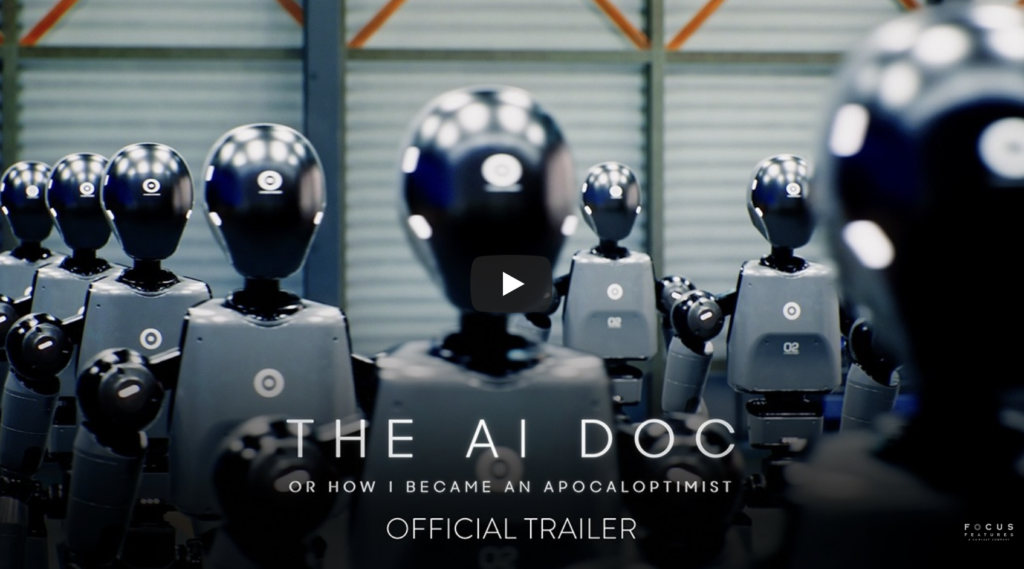
Everyone is talking about AI. Amid all this noise, however, there is still not enough focus on the real, present-day risks of AI. And that gap is reflected in the new, widely discussed film The AI Doc: Or How I Became an Apocaloptimist, which recently premiered in theaters and is already available in the U.S. on Amazon Prime Video. The film features interviews with some of the most visible leaders in the field – the very people shaping public perception of AI. But are they truly focused on the most immediate and tangible threats?
The following outlines the film’s key ideas and examines how well they align with real-world threats, drawing on insights from Ivan Shkvarun, AI fraud expert and CEO and co-founder of the digital risk intelligence company Social Links.
Few films about artificial intelligence have generated as much discussion as The AI Doc: Or How I Became an Apocaloptimist. Not because it provides definitive answers, but because it leaves important questions unresolved. Its blind spots are substantial, but they might actually turn out to be its greatest strength.
About 20 minutes of this almost two-hour film are devoted to an AI apocalypse narrative. Experts from different fields – serious, credible people – drift into doomer-style reflections and call for halting technological progress. Another part is essentially an ode to AI, full of promises about how it will help everyone. All of this is woven into the personal story of the film’s director as a future father. He asks himself whether it’s worth bringing a child into a world that might be overtaken by AI.
The film impresses with its lineup of speakers. OpenAI’s Sam Altman, Anthropic’s Dario Amodei, and Google DeepMind’s Demis Hassabis – the director managed to bring together some of the field’s most influential leaders. And that seems like a good thing. But none of them are technological experts in cyber fraud – and that’s the film’s core problem. It completely fails to unpack the real-world risks AI already poses. And that absence is telling: the people building the future are not always the ones dealing with its consequences in production environments, where systems meet adversaries rather than theory.
Why Is That a Problem?
The AI Doc is arguably the first film about artificial intelligence made for a mass audience. It features key figures and tackles what everyone is worried about – AI apocalypse versus AI salvation, depending on your perspective. It feeds both fears and hopes, but misses the point.
“Humanity is still a very long way from the kind of superintelligence people are afraid of. Meanwhile, scammers are already generating videos using the faces of your relatives, bosses, and colleagues to trick you out of money. This is a drama on a deeply human level: just imagine your mother calling you and saying she’s in big trouble – it’s terrifying. And it’s a tragedy on a business level, too. Our recent research shows that AI-driven fraud could reach $2 trillion by 2028,” says Shkvarun.
What makes this shift fundamentally different from previous waves of cybercrime is that attacks exploit trust itself as the primary vulnerability. The world is moving to where verification becomes the default condition of any interaction.
So instead of discussing urgent, tangible problems, the film leans into emotional tension between doomers and AI optimists.
Why Is That a Good Thing?
Despite its flaws, the film succeeds on many levels. The cinematography, artistic direction, lineup of interviews, and the way these elements seamlessly build the narrative make it a compelling piece of art. It resonates with its core audience – not tech-savvy viewers, but the general public seeking to understand what AI is and how it may affect their lives. And this is where its main flaw – its detachment from reality – can actually become its advantage.
Because it sparks discussion.
The way the film presents AI’s potential inevitably pushes people to question what artificial intelligence is actually capable of. And that’s where the real conversation begins: about the risks people face and what they should do about them.
Core Focus
“The film talks about the power of AI but misses an essential point. AI is neither good nor bad, but it can be used to do terrible things in the hands of bad actors. In terms of its transformative impact, this moment is comparable to the creation of the atomic bomb. Theoretically, it could lead to catastrophes on the scale of nuclear war. And that needs to be acknowledged. It might be uncomfortable, even frightening, but denying it doesn’t make it any less real,” says Shkvarun.
He adds that, unlike nuclear technology, AI is decentralized, accessible, and rapidly iterating, with no single point of control and no clear boundary between civilian and malicious use.
AI can attack. And it can do so at a massive scale. Millions of phishing emails. Thousands of deepfake videos. Generative AI tools can now produce highly personalized phishing messages in seconds. AI-automated phishing emails achieved 54% click-through rates compared to 12% for standard attempts – a 4.5x increase, says Microsoft’s 2025 Digital Defense Report. Voice cloning models can replicate a person’s speech with just a few seconds of audio. Some fraud rings already operate fully automated scam pipelines, where AI handles targeting, message generation, and even real-time conversation.
“Which means we have no choice but to develop solutions that minimize these risks. But more importantly, we need to rethink the foundation of digital trust itself: how we verify identity, how we validate information, and how we design systems that assume compromise rather than deny it.” says Shkvarun.
So maybe people should wait for the second part of the film – the one that deals with real decisions and real threats.