

Major album releases from artists like Drake, Noah Kahan, and Harry Styles draw millions of listeners, often on the same day. A February 2026 Harvard Medical School working paper found U.S. traffic fatalities increase 15% on major album release days. A new 50-state analysis from Beck & Beck builds on that finding, identifying which states leave drivers most vulnerable when distraction risks rise.
The study by Beck & Beck combines NHTSA FARS distracted driving fatality data (2019–2023) with NCSL handheld phone law enforcement classifications for all 50 states to create a Distracted Driving Vulnerability Index. States are scored on two dimensions: their distracted driving fatality rate per 100,000 licensed drivers (weighted 70%) and the strength of their handheld phone law enforcement (weighted 30%). The index is framed by a February 2026 Harvard Medical School working paper (NBER w34866) that found U.S. traffic fatalities increase 15% on the days major music albums are released, 182 additional deaths across the 10 most-streamed album release days between 2017 and 2022.
Key Findings
- New Mexico ranks #1 on the Distracted Driving Vulnerability Index with a score of 100, the highest distracted driving fatality rate in the nation (16.95 per 100,000 licensed drivers) and no statewide handheld phone ban.
- 9 of the top 10 most vulnerable states have no statewide ban on holding a phone while driving, leaving drivers unprotected on the days a Harvard Medical School working paper links to a 15% spike in traffic fatalities.
- Missouri ranks #20 with a Vulnerability Score of 27.0, one of only three “Weak Ban” states where police cannot pull a driver over solely for holding a phone.
- Louisiana has the 2nd-highest distracted driving death rate in America, but drops to Vulnerability Rank #9 after enacting a strict primary enforcement ban in August 2025, demonstrating the measurable impact of enforcement strength.
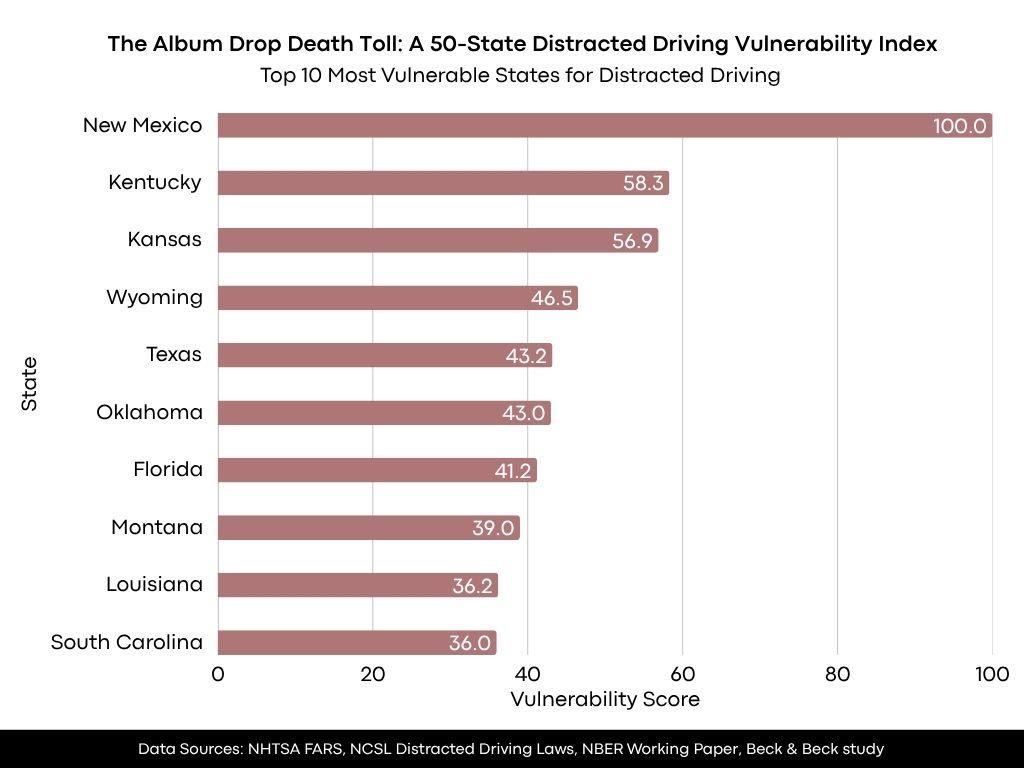
Top 10 Most Vulnerable States for Distracted Driving
| Rank | State | Avg Annual DD Fatalities (2019–2023) | DD Fatalities per 100K Drivers | Handheld Phone Ban Status | Vulnerability Score |
| 1 | New Mexico | 252.6 | 16.95 | No Statewide Ban | 100.0 |
| 2 | Kentucky | 211.0 | 7.08 | No Statewide Ban | 58.3 |
| 3 | Kansas | 138.8 | 6.72 | No Statewide Ban | 56.9 |
| 4 | Wyoming | 18.4 | 4.27 | No Statewide Ban | 46.5 |
| 5 | Texas | 639.8 | 3.49 | No Statewide Ban | 43.2 |
| 6 | Oklahoma | 88.0 | 3.43 | No Statewide Ban | 43.0 |
| 7 | Florida | 486.0 | 3.00 | No Statewide Ban | 41.2 |
| 8 | Montana | 21.0 | 2.47 | No Statewide Ban | 39.0 |
| 9 | Louisiana | 305.2 | 8.93 | Strict Ban | 36.2 |
| 10 | South Carolina | 70.4 | 1.76 | No Statewide Ban | 36.0 |
New Mexico leads the nation with a perfect Vulnerability Score of 100, driven by a distracted driving fatality rate of 16.95 per 100,000 licensed drivers, nearly 1.9 times the rate of the second-highest state, Louisiana (8.93), and no statewide handheld phone ban. Nine of the top 10 most vulnerable states share that same enforcement gap: no law on the books prohibiting drivers from holding a phone. Louisiana is the exception, despite the 2nd-highest death rate in the nation, its enactment of a strict primary enforcement ban in August 2025 pulls its Vulnerability Score down to 36.2.
“When a major album drops and millions of drivers reach for their phones to stream it, the states without enforceable handheld bans are leaving their residents exposed. Missouri’s Siddens Bening Hands Free Law is a step in the right direction, but as a secondary offense, it means police can’t pull someone over simply for holding their phone. The data shows that enforcement strength matters, and right now, too many states are falling short.” — John Beck, Attorney & Founding Partner, Beck & Beck
Top 5 Least Vulnerable States
| Rank | State | Avg Annual DD Fatalities (2019–2023) | DD Fatalities per 100K Drivers | Handheld Phone Ban Status | Vulnerability Score |
| 46 | New Hampshire | 11.4 | 1.00 | Strict Ban | 2.7 |
| 47 | California | 232.0 | 0.85 | Strict Ban | 2.1 |
| 48 | Connecticut | 16.0 | 0.62 | Strict Ban | 1.1 |
| 49 | Nevada | 12.2 | 0.57 | Strict Ban | 0.9 |
| 50 | Rhode Island | 2.6 | 0.34 | Strict Ban | 0.0 |
Rhode Island posts the lowest Vulnerability Score in the nation (0.0), combining the lowest distracted driving fatality rate among all states (0.34 per 100,000 drivers) with a strict primary enforcement handheld phone ban. All five of the least vulnerable states have strict bans and fatality rates below 1.00 per 100,000 licensed drivers. California, the most populous state, ranks 47th in vulnerability, demonstrating that strict enforcement paired with lower per-capita fatality rates can offset sheer traffic volume.
All 18 States With No Statewide Handheld Phone Ban
| Rank | State | DD Fatalities per 100K Drivers | Vulnerability Score |
| 1 | New Mexico | 16.95 | 100.0 |
| 2 | Kentucky | 7.08 | 58.3 |
| 3 | Kansas | 6.72 | 56.9 |
| 4 | Wyoming | 4.27 | 46.5 |
| 5 | Texas | 3.49 | 43.2 |
| 6 | Oklahoma | 3.43 | 43.0 |
| 7 | Florida | 3.00 | 41.2 |
| 8 | Montana | 2.47 | 39.0 |
| 9 | South Carolina | 1.76 | 36.0 |
| 10 | North Carolina | 1.64 | 35.5 |
| 11 | North Dakota | 1.54 | 35.0 |
| 12 | Arkansas | 1.51 | 34.9 |
| 13 | Wisconsin | 1.40 | 34.4 |
| 14 | Nebraska | 1.33 | 34.1 |
| 15 | South Dakota | 1.26 | 33.9 |
| 16 | Utah | 1.23 | 33.7 |
| 17 | Mississippi | 1.17 | 33.5 |
| 18 | Alaska | 0.80 | 32.0 |
Eighteen states still have no comprehensive statewide ban on holding a phone while driving. These states account for all of the top 8 positions on the Vulnerability Index. The fatality rate gap within this group is vast: New Mexico’s rate (16.95) is more than 21 times Alaska’s (0.80), indicating that the absence of a ban is only one part of the vulnerability equation, road conditions, enforcement culture, and driving patterns also play significant roles.
The 3 “Weak Ban” States: Secondary Enforcement Only
| Rank | State | Avg Annual DD Fatalities (2019–2023) | DD Fatalities per 100K Drivers | Vulnerability Score |
| 20 | Missouri | 136.4 | 3.19 | 27.0 |
| 21 | Alabama | 84.4 | 2.08 | 22.3 |
| 22 | Colorado | 90.2 | 2.06 | 22.2 |
Missouri, Alabama, and Colorado are the only three states where a handheld phone ban exists on the books but is classified as a secondary offense, meaning law enforcement cannot initiate a traffic stop solely for phone use. Missouri’s Siddens Bening Hands Free Law, enacted in 2023, places the state at Vulnerability Rank #20 with a score of 27.0. The very behavior the Harvard working paper identifies, drivers reaching for their phones to stream new music, is effectively unpoliced in these three states unless another traffic violation occurs simultaneously.
The Louisiana Effect: How Enforcement Strength Changes the Ranking
| State | Avg DD Fatalities | Rate per 100K | Ban Status | Death Rate Rank | Vulnerability Rank | Vulnerability Score |
| Louisiana | 305.2 | 8.93 | Strict Ban | 2nd | 9th | 36.2 |
| New Mexico | 252.6 | 16.95 | No Statewide Ban | 1st | 1st | 100.0 |
Louisiana illustrates the power of enforcement classification within the index. With 305.2 average annual distracted driving fatalities and a rate of 8.93 per 100,000 licensed drivers, it holds the 2nd-highest death rate in the nation. But Louisiana enacted a strict primary enforcement handheld phone ban in August 2025, which drops its Vulnerability Score from what would have been 66.2 (if scored as a no-ban state) to 36.2, a demonstration that law enforcement tools can meaningfully shift a state’s exposure profile, even before fatality rate improvements are reflected in the data.
Methodology
Beck & Beck analyzed NHTSA Fatality Analysis Reporting System (FARS) data for distraction-affected fatal crashes across all 50 states, averaged over 2019–2023, and normalized by licensed driver population to produce a fatality rate per 100,000 drivers. Each state’s handheld phone law was classified using NCSL data as Strict Ban (primary enforcement, score 0), Weak Ban (secondary enforcement, score 50), or No Statewide Ban (score 100). The composite Vulnerability Score weights the fatality rate dimension at 70% and the enforcement dimension at 30%, producing a 0–100 scale from least to most vulnerable.