

With gold prices recently crossing the $5,000-per-ounce threshold for the first time in history, the economics of gold exploration and development companies have shifted dramatically. One company that has been surfacing in junior mining circles is Tiger Gold Corp. (TSXV: TIGR | OTCQB: TGRGF | FSE: D150), a gold exploration and development company advancing a significant gold asset in Colombia’s most active mining district. The company is positioning itself as a potential standout among junior gold developers.
Here is a closer look at where Tiger Gold stands today and what investors should know.
The Mid-Cacau Belt – Producing World Class Mines
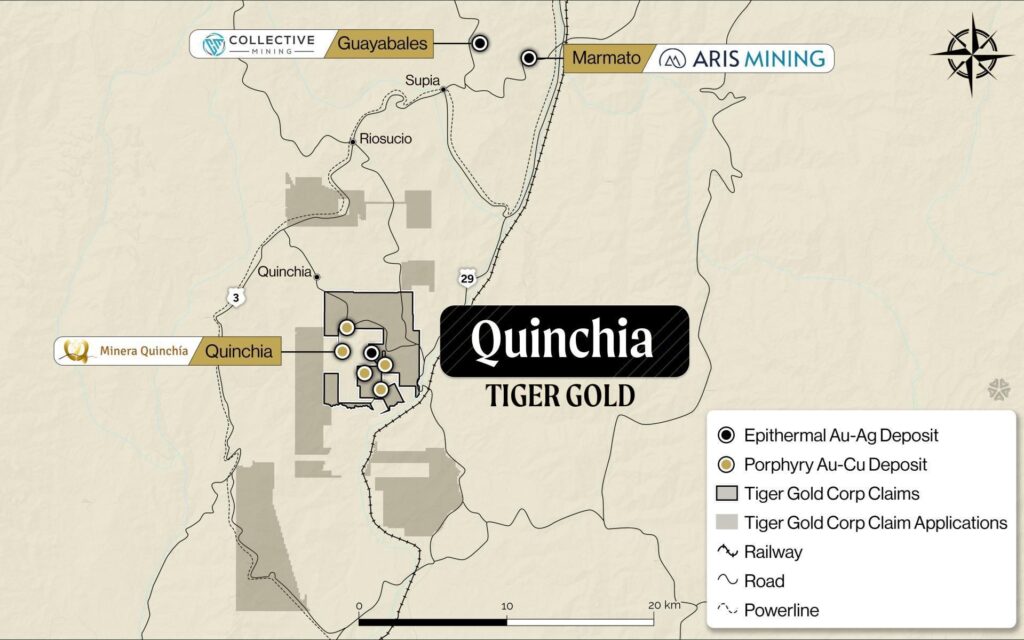
Tiger Gold is a growth-stage mining exploration and development company focused on its flagship Quinchia Gold Project, located in the Department of Risaralda in central Colombia. The project sits squarely within the Mid-Cauca gold belt, a geological corridor that hosts some of Latin America’s largest gold deposits and producing mines. Neighboring operations include Aris Mining’s Marmato Gold Mine and Collective Mining’s Guayabales and San Antonio projects, all located within approximately 20 kilometers of Tiger Gold’s land package.
Colombia itself has become a destination of choice for mining capital. The country offers over 500 years of mining heritage, a pro-mining regulatory environment, paved road access, abundant hydroelectric power, and a skilled local workforce. For companies operating in the exploration and development phase, these infrastructure advantages can meaningfully reduce both costs and timelines.
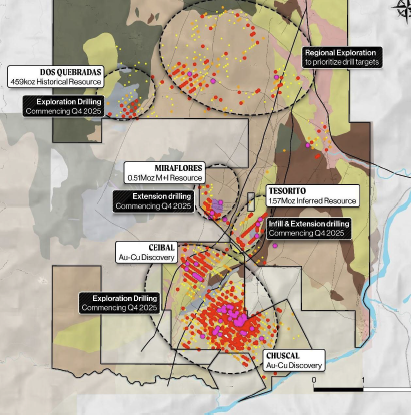
The Quinchia Gold Project encompasses three key areas: the Miraflores and Tesorito deposits, which hold current NI 43-101 compliant mineral resources, and the Dos Quebradas prospect, which carries a historical inferred mineral resource estimate of 20.2 million tonnes at 0.71 g/t gold (approximately 459,000 ounces). The company cautions that a qualified person has not done sufficient work to classify the Dos Quebradas estimate as a current mineral resource, and Tiger Gold is not treating it as such.
According to data from Stockopedia, the combined Quinchia project hosts approximately 510,000 ounces of gold in the Measured and Indicated categories at Miraflores, plus roughly 1,580,000 ounces of Inferred resources across Miraflores and Tesorito. That puts the total resource footprint in the range of 2 million ounces or more when accounting for Dos Quebradas, though the historical nature of that estimate warrants caution.
Strong Base Case with Significant Upside
A Preliminary Economic Assessment completed in September 2025 by Ausenco Engineering evaluated the Miraflores and Tesorito deposits under a base case gold price assumption of US$2,650 per ounce. The study returned a post-tax net present value (at a 5% discount rate) of US$534 million, an internal rate of return of 21.3%, and a payback period of 3.83 years. Average annual payable production was estimated at 138,000 ounces of gold and 104,000 ounces of silver (141,000 ounces gold equivalent) over a projected 10-year mine life, with all-in sustaining costs of US$1,340 per ounce of gold.
What makes these figures particularly interesting in the current environment is the gap between the PEA’s assumed gold price and where the metal actually trades today. With gold hovering near $4,800 per ounce as of mid-April 2026, the PEA was modeled at roughly half of current spot prices ($2,650). The project’s NPV rises to over US$1.2 billion when evaluated at US$3,700 per ounce of gold, a price that is itself now well below the current market.
Investors should note, however, that a PEA is preliminary in nature and includes inferred mineral resources that are considered too speculative geologically to have economic considerations applied to them. There is no certainty that PEA results will be realized, and actual project economics will depend on a range of factors, including permitting, metallurgy, capital costs, and future commodity prices.
Three Rigs Turning in Colombia
Tiger Gold’s Phase 1 drill program, planned for 10,000 meters, began in November 2025 with two rigs at the Tesorito deposit. A third rig was mobilized in January 2026 to begin drilling at Dos Quebradas. The company has been reporting results at a steady pace, and the data released so far has been noteworthy.
In January 2026, the company reported that drillhole TSDH-68 at Tesorito returned 139.6 meters grading 0.9 g/t gold from just 0.8 meters below surface, including 30 meters at 1.3 g/t gold. The company noted these grades were higher than what existing models predicted, particularly near the margins of the deposit. Later that month, drillhole TSDH-71 delivered 82.7 meters at 1.4 g/t gold within a wider envelope of 307.1 meters grading 0.7 g/t gold, reinforcing the company’s view that the system carries broad, continuous near-surface mineralization.
The most recent results, announced February 24th, 2026, included drillhole TSDH-71, intersected the potential feeder zone at Tesorito, where gold grades jumped significantly. Tiger reported 89.96 meters at 0.9 g/t gold from 426m downhole. Including 16.9 m grading 2.3 g/t Au, 0.25% Cu, and 158 ppm Mo, including 6 m grading 4.1 g/t Au, 0.43% Cu, and 302 ppm Mo.
CEO Robert Vallis called it one of the strongest holes the company has drilled to date. Importantly, the batch of results also identified geological vectors suggesting the Tesorito system may remain open to the south and southeast, areas that have not yet been systematically tested. Follow-up drilling is now underway to evaluate those extensions.
All drill results referenced above are sourced from Tiger Gold’s public press releases, available here.

Management Team and Positioning
One element that often separates junior miners that execute from those that do not is the quality of the team. Tiger Gold is led by President and CEO Robert Vallis, a 28-year mining executive who previously held senior roles at Barrick Gold and Yamana Gold. His experience includes involvement in Barrick’s US$9.5 billion acquisition of Placer Dome and the US$3.9 billion joint acquisition of Osisko Mining by Yamana and Agnico Eagle Mines. The broader leadership group includes professionals with operational and technical backgrounds at AngloGold Ashanti, B2Gold, and other globally recognized producers.
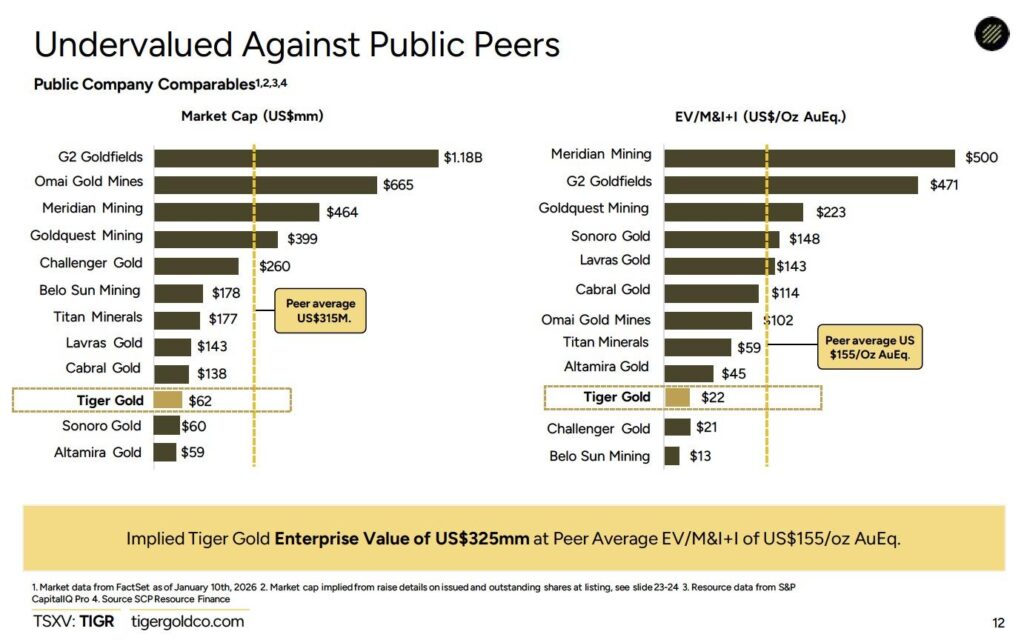
On the financial side, Tiger Gold closed a brokered private placement in late 2025, co-led by SCP Resource Finance and Canaccord Genuity, which was ultimately upsized to approximately $16.3 million. With roughly 103 million shares outstanding and a recent share price in the range of CAD $0.80, the company’s market capitalization sits in the neighborhood of CAD $85 million. That positions Tiger Gold at a fraction of its peers, though investors should weigh the considerable distance between a PEA and a producing mine.
The company now trades on three exchanges: the TSX Venture Exchange (TIGR), the Frankfurt Stock Exchange (D150), and the OTCQB Venture Market in the United States (TGRGF).
What to Watch for Next
The catalyst pipeline for the remainder of 2026 is relatively clear. Ongoing drill results from the Tesorito infill and extension program, as well as new ounces being discovered at the company’s nearby CEIBAL and CHUSCAL deposits, should continue to flow in the coming weeks. The Dos Quebradas drilling campaign is in its early stages, with results expected in the coming weeks. The company has stated its intention to use Phase 1 results to support an updated mineral resource estimate and advance the project toward pre-feasibility level studies.
For additional company updates, investors can visit the official website, review media and presentations here, and follow the company on Instagram for field content and exploration updates.
Whether Tiger Gold ultimately delivers on the potential outlined by its PEA and early drill results remains to be seen. But in a gold market that has moved decisively to around $4,800 per ounce, companies with defined multi-million-ounce resources, active drill programs in proven districts, and experienced teams tend to attract serious attention. Tiger Gold appears to be checking those boxes in Colombia, and the market is beginning to take notice.
Disclosure: This article is for informational purposes only and does not constitute investment advice, a solicitation, or a recommendation to buy, sell, or hold any securities. Mineral resources that are not mineral reserves do not have demonstrated economic viability. A PEA is preliminary in nature and includes inferred mineral resources that are too speculative geologically to have economic considerations applied to them. There is no certainty that PEA results will be realized. Forward-looking statements involve known and unknown risks, and actual results may differ materially. Investors should conduct their own due diligence and consult a qualified financial advisor before making any investment decisions.