
In an industry that has barely budged since the days of the Civil War, one Marine veteran is laying down a new kind of track, literally.
Tim Noonan, founder and CEO of Evertrak, is leading a charge to modernize one of the least disrupted sectors in U.S. infrastructure: railroad ties. His company, based in St. Louis, is manufacturing Glass Fiber Reinforced Polymer (GFRP) ties made from recycled plastics; a durable, sustainable alternative to wood that’s already winning over Class I railroads.
More than 100,000 Evertrak ties are already in service, proving their strength and staying power on some of the nation’s busiest lines. But what’s more striking than the material itself is the mission driving it, one rooted in veteran leadership, innovation, and a commitment to rebuild smarter.
From the Marine Corps to the Main Line
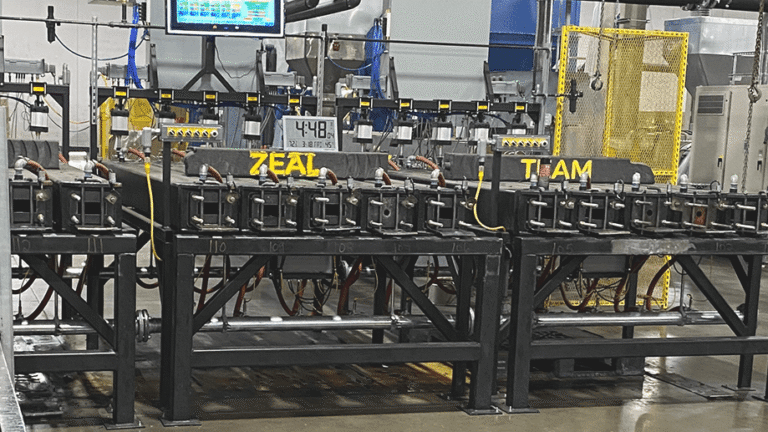
For Noonan, the work is personal. “The team, the team, the team,” he often says, a mantra carried from his Marine Corps service into his business philosophy. It’s less about hierarchy and more about collective grit.
Since founding Evertrak in 2017, Noonan has built a company culture defined by mission discipline and engineering excellence, backed by an ethos of service. “We’re not just preventing deforestation or recycling plastic,” he says. “We’re showing what it looks like when innovation and care go hand in hand.”
That leadership ethos, service before self, radiates throughout Evertrak’s growing workforce. Many are veterans themselves, bringing field-tested problem-solving skills and adaptability to the production floor. It’s no coincidence that this startup has earned a reputation for precision and reliability.
As Noonan puts it, “We’re here to win battles that wood can’t fight.”
The Real Cost of Wood: Paying Forever
Railroad ties, the rectangular beams that support and stabilize steel rails, might seem mundane, but they’re the backbone of global commerce. In the U.S. alone, railroads replace tens of millions of ties each year, most of them still made from wood.
Yet the economics of timber ties are changing. Supply constraints, rising lumber costs, and shorter lifespans are tightening budgets and timelines across the industry.
Evertrak’s advisory board member Ricky Johnson, a longtime decision-maker in major railroad procurement, knows the pain points firsthand.
“Wood ties in high-rot zones fail in 8 to 15 years,” Johnson explains. “You think you’re saving money upfront, but you’re not seeing the full picture, the replacements, the disruptions, the disposal costs. It’s a hidden tax on infrastructure.”
That insight drives Evertrak’s case for total cost of ownership, a concept that resonates deeply with engineers and CFOs alike. A single Evertrak tie can last 50 years with no disposal cost; when it’s done, it’s recyclable.
“The math is simple,” says Johnson. “Pay once for 50 years of performance, or pay repeatedly for declining results.”
Material Science Meets Manufacturing Scale
At the heart of Evertrak’s innovation is its Evertrak 7000 composite tie, engineered for strength, consistency, and endurance.
Brent Laing, P.Eng., former VP of Engineering at Canadian National Railway (CN), breaks it down: “When you buy hardwood ties, you can get five different species, each with different properties. Evertrak ties guarantee identical composition and identical performance. Every time.”
That kind of predictability is gold in rail engineering, where consistency is safety.
What once was considered a “premium” option is rapidly becoming the cost-competitive standard. As timber prices fluctuate and performance data accumulates, Evertrak is edging toward price parity, a milestone that could tip the balance for the entire rail industry.
Wood where it works. Evertrak, where it doesn’t. Simple as that.
The Broader Picture: Sustainability and Security
The implications reach far beyond cost.
The U.S. railway network spans more than 140,000 miles, a massive ecosystem tied to national logistics, defense readiness, and supply chain resilience. Replacing even a fraction of wood ties with longer-lasting composites could yield enormous savings in material use, maintenance, and emissions.
Evertrak’s model of using recycled plastics that might otherwise end up in landfills or oceans turns waste into infrastructure. It’s a circular economy in action, grounded in American manufacturing and veteran-built integrity.
As supply chains face increasing scrutiny and sustainability becomes a national imperative, Evertrak represents a distinctly American solution: durable, domestic, and data-backed.
Leadership with Purpose: The Evertrak Ethos
If Noonan sounds like a man on a mission, that’s because he is. His approach to leadership borrows directly from his time in uniform: clarity, camaraderie, and conviction.
“The greatest innovation doesn’t come from technology alone,” he says. “It comes from people who care deeply about doing the right thing, even when it’s harder.”
On the plant floor in St. Louis, that ethos is visible. Each composite tie tells a story of material science meeting moral clarity, a solution that respects the past while building for the future.
Wood ties built America’s railroads. Evertrak ties are building what comes next.
Veterans Day and Beyond
This Veterans Day, Evertrak’s story resonates as more than an industrial success. It’s a case study in how veteran leadership continues to shape the nation’s most critical infrastructure, not through nostalgia, but through next-generation thinking.
Noonan’s vision is clear: “We’re building better railroads, yes. But we’re also building better teams, ones that prove sustainability, performance, and American grit aren’t at odds.”
Or, as he likes to sign off: Semper Tie.